



A year ago, I published a book arguing that democracies can make immigration popular by making it demonstrably beneficial. In the months since, the United States ran something close to the opposite experiment. Mass deportations and a “border” enforcement surge reached even in decidedly non-border cities like Charlotte, NC where I was living at the time. It became a year-long case study in what happens when a policy many voters backed in the abstract becomes, in practice, hard to see as serving their interests. And it came right on the heels of the Biden years, when an administration that wanted to be humane lost control of the border and paid for it politically. In barely two years, the country had produced two opposite failures and a fast lesson in how quickly immigration politics can swing.
But the test I was most worried about did not come from Washington. It came from Canada. The book leans on Canada as its clearest case of immigration done right, and I had said, more than once, that if Canadian support for immigration ever collapsed, it would invalidate part of my thesis. Over the past two years, it came closer to that than I thought possible. So I want to spend this publication anniversary explaining what happened and why the backlash against immigration in Canada still fits the argument I made in In Our Interest, and recalibrate a bit. In short, Canada’s “backlash” has been much more about speed, housing, and temporary flows than about crime or ethnic identity, while the selective core of the system remained uncontested.
Is there a popular backlash against immigration in Canada?
Of course, I never claimed in the book that Canadian opinion could never turn. But a swing this fast, in the country I held up as the model, cuts against the grain of my argument, and I owe readers an honest account before I move to the defense.
Drawing on Environics survey data going back to the 1970s, my book showed that the share of Canadians who think immigration is too high had fallen for decades, from around 70 percent in the early 1990s to under 30 percent by 2020. All consistent with the idea that Canada achieved a high-immigration system that most people actually like by running it as a selective, orderly program whose benefits were visible to ordinary people. This is what I meant by demonstrably beneficial: a policy whose payoff you can grasp without a degree in economics, not a claim that all immigration is automatically good. My last data point sat near the bottom of that long decline. It was, in hindsight, almost the worst possible place to stop drawing the line.
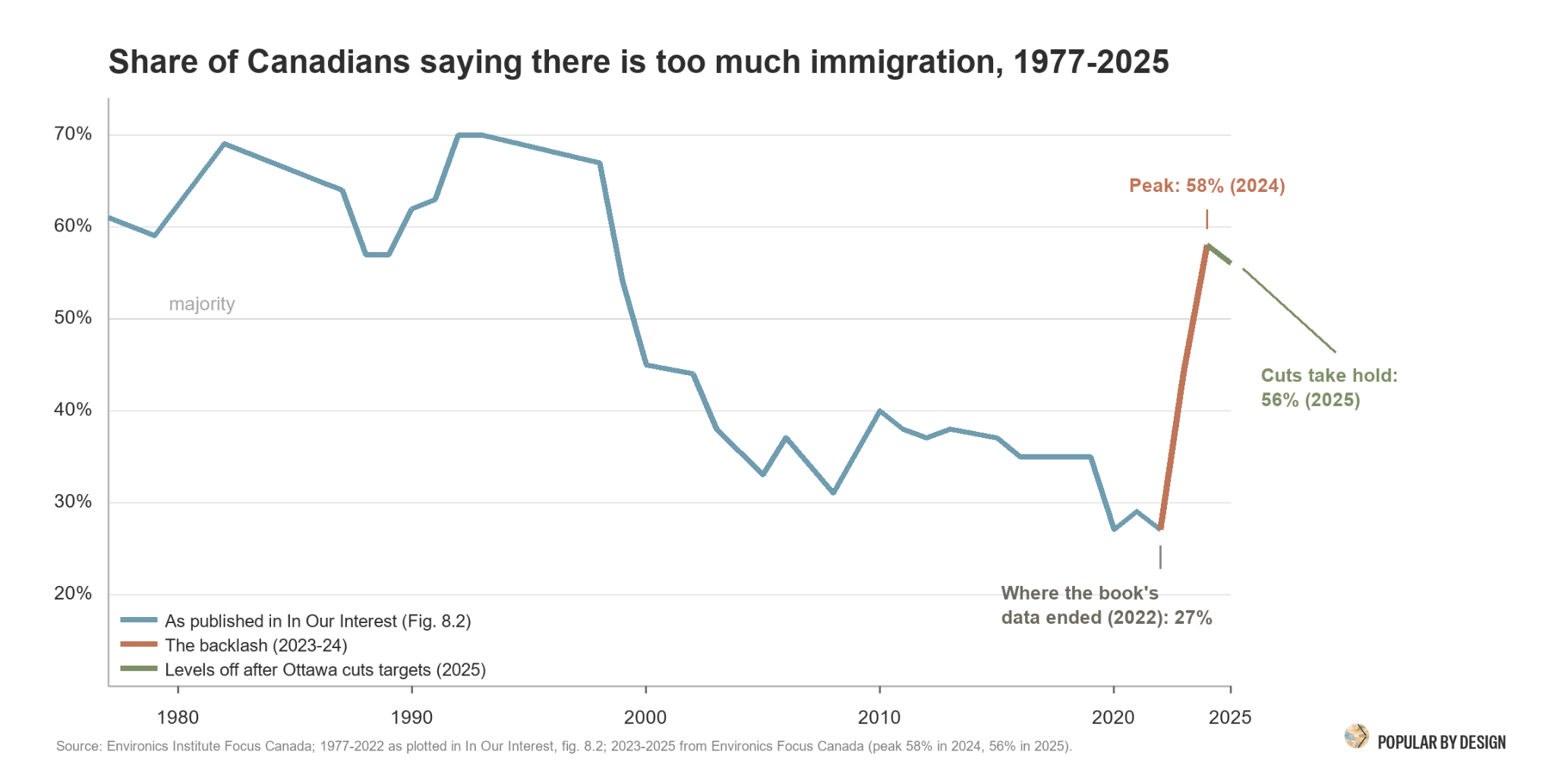
Because here is the picture now. Agreement that immigration is too high jumped 17 points in 2023, then another 14 points in 2024, reaching 58 percent, the first clear majority since the late 1990s and the steepest climb in the half-century where Environics has asked the question. The line I published as evidence that immigration can be made durable turned and shot upward almost the moment the book came out. I would be lying if I said that it did not sting.
After nearly every talk I give on the book, a hand goes up, and someone asks, “What is going on with Canada?” The vibes are bad, and they are bad in places that did not feel that way before. For instance, in October Alberta is set to hold a province-wide referendum carrying five explicit anti-immigration questions, a ballot move with no real precedent in modern Canadian politics.1 You could line the chart’s spike up with that and tell a clean story: Canada has finally joined the rest of the developed world in a right-wing immigration backlash, and the fuss I made about demonstrably beneficial policy turned out to be wishful thinking.
What actually did and did not happen
As I show in the book, this is usually what we see across the world: there are people who can be labelled “committed nativists” and “committed cosmopolitans,” each around 10 percent of the public, who rarely budge on immigration. What usually moves is the large middle. I call this majority of voters altruistic nationalists: they care about newcomers but weigh their own compatriots first, and they back immigration when they can see it working for the country.
Over the last few years, Canada’s middle majority have not seen immigration working as well as it used to. Canada scaled temporary residents and international students faster than housing and services could absorb them, the textbook condition under which the diffuse and often invisible benefits of immigration shrinks while its concentrated costs swell. Even so, a majority of Canadians still say immigration is good for the economy, and when Environics asks the people who want less why, they point overwhelmingly to housing and the cost of living, not to crime or culture.
The book actually flagged this risk in the Canada chapter, noting that the post-pandemic surge in international students, plus a housing shortage, had already begun to produce dissatisfaction. What I got wrong was the speed of the public confidence decline: I assumed a system this good would keep absorbing shocks without a serious political reaction.
But notice, too, what the most recent opposition actually targets. Pierre Poilievre and the Conservatives ran hard against temporary residents and students while leaving the skilled, points-based core of the system alone; even the country’s most restrictionist federal party, the People’s Party, has proposed capping permanent admissions at 100,000 to 150,000 a year, a sharp cut from today’s pace but a level that would still admit several times what most other rich democracies do. The argument in Canada has effectively been about how much and how fast, while the principle of selecting immigrants for national contribution goes essentially unchallenged.
Even at its angriest, the backlash never turned Canada into a restrictionist country. Gallup still ranks it the most migrant-accepting society in the world, and even after the recent cuts, Canada is on track for roughly 395,000 permanent admissions in 2025, near one percent of the population a year, more than double the United States’ rate per capita and above the OECD average. Even if every one of Alberta’s referendum questions passed, they could not override the federal totals. A Canadian who complains of “too many immigrants” is still open to an extraordinary number of immigrants. A Canadian who says there is too much immigration and, let’s say, a Japanese voter who says the same thing are not asking for remotely the same world.
The dial has also already started to move back. Faced with the backlash, Ottawa did the both responsive and responsible thing: it cut permanent-resident targets from 500,000 to 365,000 by 2027, imposed the first-ever caps on temporary residents and international students, and set out to shrink the temporary population to about 5 percent of the country’s population.
Opinion is already tracking the policy. Environics’ 2025 reading shows the “too many” number leveling off at 56 percent, the first year in three it stopped climbing, and the people who still hold that view increasingly describe it as a failure of government management, not as a problem with immigrants.
The refinements: thermostatic politics, credibility, and salience
The whole recent Canadian sequence is what thermostatic politics looks like: while deep attitudes barely move,2 the dial of “too much” or “too little” adjusts to whatever the government is actually doing in response to those attitudes. Overshoot what the public can absorb, and the dial swings; correct the policy, and the dial swings back. I gestured at this in the book. But I should have built a chapter on it, because it turns out to be the engine of the whole story.
The same mechanism just ran in the opposite direction south of the border. As enforcement escalated from the border into workplaces and neighborhoods, the share of Americans who told Gallup they wanted less immigration fell from 55 percent in 2024 to 30 percent in 2025, one of the sharpest reversals on the question in decades. Same thermostat, opposite setting. As I argued in a guest piece for Alex Nowrasteh’s Substack, competence builds trust, and chaos invites dissatisfaction, whether the chaos is restrictionist or expansionist.
The other refinement is about the importance of credibility. Demonstrable benefit only holds support when voters find it credible, and credibility, as Canadian housing politics has shown, is much easier to lose than to build. Once a community sees an acute housing shortage that can plausibly be blamed on a surge in arrivals, even a system that had been working stops being seen as beneficial. The visible benefit and the credible attribution have to travel together.
The same point came through more sharply from the American side. Consider what happened to the Harris campaign’s late attempt to look tough on the border. In her September 2024 Douglas, Arizona speech, she promised to “bring back the border security bill that Donald Trump tanked” and to “do more to secure our border to reduce illegal border crossings,” language that would have read as a Republican script a few cycles earlier. It did not move the needle. Voters continued to trust Trump on the border by wide margins. No matter what Harris said by then, voters had little reason to treat the pivot as credible after the previous Democratic administration had presided over visible border disorder. Their skepticism made total sense.
This all now points us back to the actual policy. Demonstrable benefit and credibility are the same project seen from two angles: a policy earns credibility by being implemented and producing benefits people can see, which is why you cannot shortcut it with a pivot. A promise of orderly, beneficial immigration is worth very little until voters have watched you keep it. And it is the credibility of mainstream parties and politicians, specifically, that matters most: the way trust in the center-left or center-right to handle immigration well is built up over multiple terms and then squandered in one episode of total dysfunction.
The third refinement is issue salience. For a long time, Canada came unusually close to what I still think is the best political outcome for immigration: a mostly boring, technical policy area nobody cares about, closer to something like “international measurement standards” than to a culture-war battlefield. Voters cared about whether the system worked, but they did not organize their politics around it. That is much harder to sustain once immigration becomes one of the main things people blame for housing shortages, crowded services, or a general loss of control.
That is why Canada now worries me more than it did when I finished the book. Once a quiet technical issue becomes a top-line political issue, the margin for error shrinks. Every backlog, administrative failure, or local pressure point starts to stand in for the system as a whole. And because immigration opponents tend to care more intensely about reducing immigration than supporters care about expanding it, the politics can move quickly once the issue rises on the public agenda.
Where the project goes next
So where does my book and research go from here? Three directions, concretely.
First, the empirics of demonstrable benefit, and the credibility that follows from it. I want to know what voters actually have in mind when they say a policy is nationally beneficial: which features they register, which they ignore, and how long a government has to deliver before its promises start to seem credible. The book basically asserted the construct, and the next step is testing it rigorously, which is among the first questions I want to take up through the immigration lab I am starting at Notre Dame.
Second, issue salience and ownership. I want to understand when immigration becomes one of the issues voters use to judge whether a government is competent, and who they then trust to handle it. In work I am now doing with James Dennison, we’re trying to figure out how that dynamic travels beyond immigration as well: when an issue becomes politically available, who gets to own it, and how mainstream parties can keep hard policy problems from becoming permanent trust problems.
Third, humanitarian design, which is the hardest case for the argument and the part of the book I most want to extend. The way to protect humanitarian immigration is to build public trust first, through visible benefits and shared responsibility. That is the case I made in a recent policy brief, and the next step is testing which combinations of sponsorship, faster decisions, and credible limits actually hold up politically.
In Our Interest was an academic book by design (I had to finish my dissertation and get an academic job, folks!), and I am proud of the research behind it. But its argument deserves a more direct public life too, which is part of what this newsletter is for: the same case, in a register that meets readers where they actually are.
A year ago, the question under every other question, in rooms from an Oxford lecture hall to a retiree center in Charlotte, was whether any of this is realistic, or whether making immigration popular is a fantasy that collapses the moment real politics arrives. After the year we just had, the year that bent my favorite chart the wrong way and then began to bend it back, my answer is steadier than when I started. Immigration support becomes durable when people can see it is working, and the work of showing them is never finished. That is still, for everyone involved, in our interest.
Many thanks to more than a thousand3 of great folks who read, reviewed, argued with, or hosted the book over the past year. If you haven’t had a chance to check it out yet, for the full argument and the evidence behind it, the book is still the place to go. For the next stage of the project, this newsletter is where I am taking it. And if you want a say what should come next, tell me in the comments. You can find the rest of the year’s talks, reviews, and podcast conversations on my media page.
The questions themselves are mostly about scarce provincial capacity: control over admissions, temporary residents' access to health care and education, waits for social supports, and proof of citizenship to vote.
My earliest published work found general immigration attitudes are remarkably stable
At least according to my publisher, personal stats, and the royalty check I just got :)
This one's a strong contender for the Housing Theory of Everything. People weren't mad at immigrants, they were mad at rent costs going haywire and looking for a scapegoat.
The targeting of student visas supports your point even though it might not look it to casual observers. Everyone knew that many of the schools were using student immigration pathways to sell access to Canadian immigration status, thereby serving as an unintentional pathway for low-skilled immigrants. And because they were selling the promise of post graduation work permits and eventual permanent residence rather than education, the degrees from these schools were worth less than toilet paper because everyone knew what the product really was