


How to use AI for research and data analysis is by now reasonably well-discussed, and the issue of AI writing is still controversial but at least has a lively debate around it. Using AI to reach the public or assist your workflow as a public writer, however, is almost untouched. After a year of experimenting with those uses, my sense is that the constraint is imagination rather than capability. In May, I gave a talk about my experience for Machine Collaborators, a workshop series on how researchers work with AI. What follows is the written version, which is a more practical kind of post than I usually publish here, and it’s intentionally designed to be useful even to those folks who don’t want to outsource any of their precious writing to the machine at all.
I spent the spring arguing in three separate posts that academics need to wake up on AI, changed my mind about detectors when Pangram turned out to work, and then doubled down on the idea that AI writing can be legitimate in many contexts. As I recounted to The Chronicle of Higher Education, some folks were calling to fire me for those blasphemous thoughts, while others kept privately messaging me to ask about my setup (sometimes the very same people). But even the sharpest critics I engaged with, at least outside of Bluesky, usually concede that AI has been good for doing research—just not writing about it yet. So I want to set the writing question aside and start from a friendlier premise.
Let’s say you have done your research, written it up, and had it published. It is now sitting in a journal that few people read. You would like more people—especially those of the influential kind—to read about your work and findings. With a custom style guide and proper verification, an AI agent can carry much of that promotional load by creating accessible write-ups, data companions, and interview prep packets. This post is a tour of how to start.
My academic readers may remember that I made the fuller case for scientific public engagement, especially vis-à-vis “scholar activism,” in an earlier post. In short, writing for necessarily diverse, non-academic audiences stress-tests your ideas and keeps good research from staying invisible. But I do not want to pretend the current incentive structure in academia encourages this kind of engagement outside the field. Unless you’re in a policy school, public engagement normally counts for little in promotion files. Skipping it has been a defensible use of your scarce time, especially if you don’t enjoy it. At least, that was true until AI agents came around.
Writing a public-facing piece built on research I had already done used to take me about a week. With some agentic assistance, it now takes me less than a day without sacrificing any quality. The bar for “worth doing” drops accordingly, and a whole set of projects that never made sense before—like a translated website or an automated idea tracker—suddenly do. The limits are again mostly about your creativity.
The basic setup you need for now (2026 Q3)
One reason it took me some time to publish this piece specifically is that the shelf life of any concrete AI tip is quite short given the rapid development of these tools. The only durable tip I’ve learned is that you can just talk to your AI agent and ask it to do things for you the way you would ask your human (research) assistant. Relatedly, I’ve come to believe in the general principle that, if there is something that’s ethical to outsource to your human assistant, it should be similarly ethical to outsource it to your AI assistant. With your own verification, this should be true regardless of whether we’re talking about creating outlines, summarizing sources, gathering data, and even writing formulaic email responses to administrative requests. The assistant analogy is only a floor, though.1 Today’s agents are also competent programmers and decent designers, so once the routine tasks are covered, the same setup can take on far more ambitious projects, like the interactive research companions I describe at the end of this post.
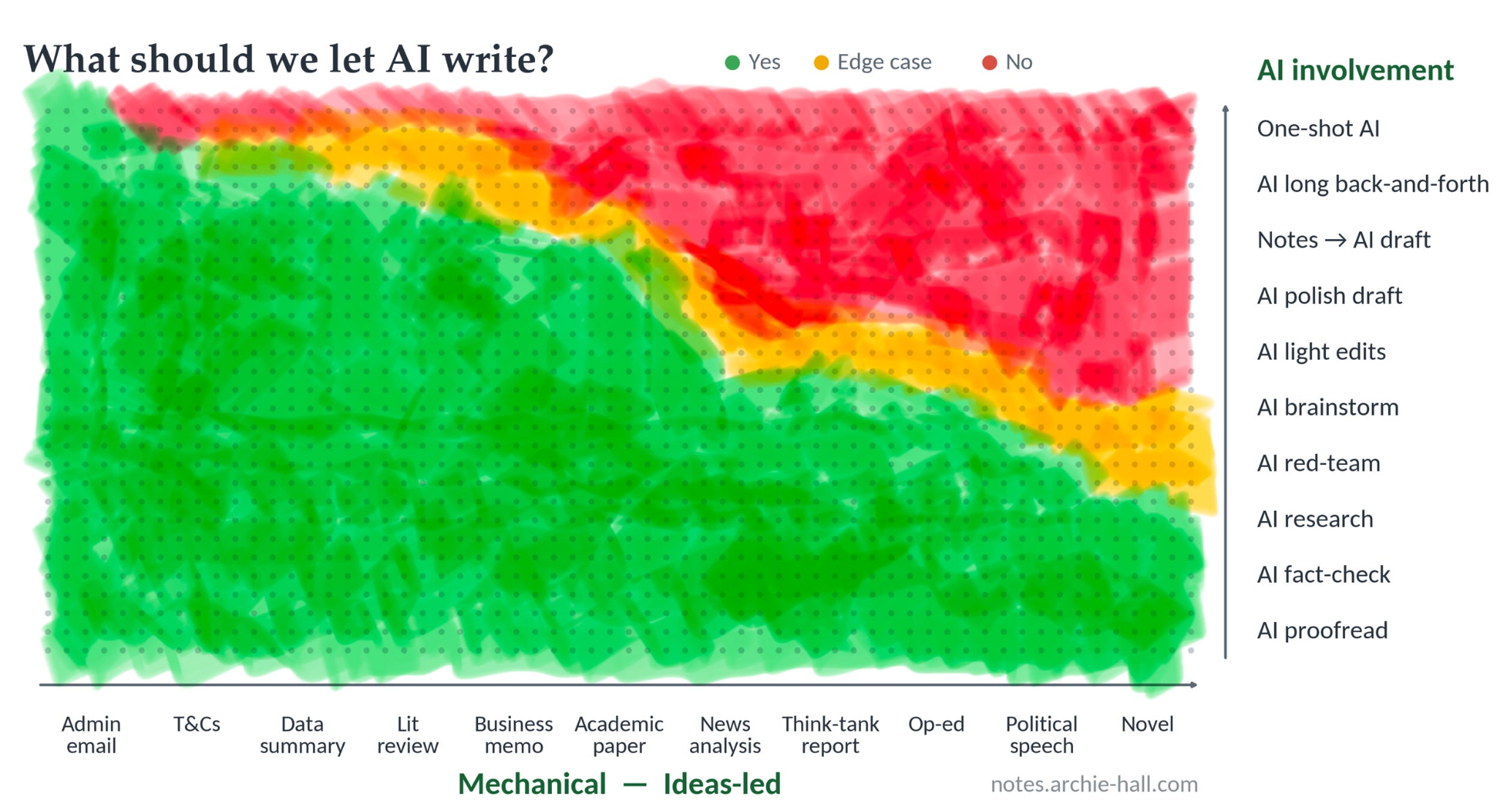
Reasonable people still disagree on how much actual writing you should be able to outsource to AI, but it is clarifying to think of it as a continuum rather than a binary. Here’s one good example by Archie Hall, building on my own case against Pangram from earlier.2 Archie and I don’t quite agree on where to draw the line (his yellow/orange is my green), but even for those of you who are even more conservative than Archie, there is plenty of exciting stuff you can do to improve your research’s public engagement.
Here are a few specific things all quantitative social scientists may find useful. This is very basic stuff, but I’ve seen folks who are still confused about the difference between Codex and ChatGPT, so it makes sense to be explicit:
Pay for at least one premium model. The serious agentic tools (I use Claude Code and OpenAI Codex) sit behind subscriptions of about $100-200 a month, and the free tiers will mislead you about what is possible.3
Use an agentic system, not a chatbot. That is, don’t use Claude or ChatGPT in your browser, even when you have a project folder. You need an “agentic tool” that gets access to your computer to work directly in your files until the task is done, while making changes in the real world, like updating your website.
Get a GitHub account if you do not have one. Agents work best in folders with version history, and you will want the ability to undo. Here is a good guide for beginners.
Talk to your agent when you do not understand something, preferably using dictation. The setup questions that used to require a programmer friend can now be answered, patiently and specifically, by the tool itself.
Keep and periodically update a common instruction file such as CLAUDE.md or AGENTS.md. Every correction you make twice goes in there once, so the agent stops repeating the mistake.
Always verify output, especially anything for public consumption, both with AI (yes) and personally. More on this below.
Why you still need an agent and why a chatbot with a project folder is still not that
I should say a few more words on this, because some of the folks who reviewed this piece were still not sold on using an agent. They already talk to Claude or ChatGPT in the browser every day, they keep project folders with their papers uploaded, and they reasonably ask what else a researcher could need.
The difference is what happens after the model finishes thinking. Everything you do within a chat window is just information: you still have to carry the answer somewhere and act on it yourself. Things you do with an agent are actionable in terms of impacting the real world around you, like updating and publishing your website, or fixing and uploading your code, or sending an email invite.
Using a project folder, useful as it is, is not enough. And it’s not just about having to copy and paste less from your chatbot window. Uploading your papers and relevant materials to the project folder changes what the chatbot knows; an agent changes what AI can practically do with the files you share. Since the agent also has access to your computer and the terminal, you can do more sophisticated things like the writing skill that I describe below, which lives in files the agent reads and updates every time it writes. The same goes for your browser: an agent working through it, with your logins and permissions, can reach far more than the AI’s own built-in browsing. My suggestion is, again, to just try it on one concrete task (e.g., writing interview prep) and compare it to the output from a chatbot for yourself (e.g., Claude Fable 5 vs Claude Code Fable 5). But the whole endeavor of building and updating your own website below is the perfect candidate to see the difference for yourself.
Step zero is always building an AI-assisted personal website
Everything that follows assumes you have a home on the web you control, which, for most academics, means a personal site. If you do not have one as a researcher, get one ASAP, and this is the first thing you can ask an agent for. I created my website by hand using Jekyll with the AcademicPages template about seven years ago. I’m stuck with it now, at least emotionally, but there are more good options available now to start from scratch.
Your website can be hosted for free on GitHub Pages or on a personal domain (e.g. on Squarespace), which costs about $10 a year. Back in the day, as a non-coder, it took me forever to set up my site the way I wanted, even with the help of various guides. With agentic AI, the whole thing can take as little time as one evening. From then on, the site effectively edits itself. Small upgrades cost an afternoon each. You can describe a change in plain English, like adding tags to your publication list, and the agent adds that feature by itself. The only thing you need to do, apart from any local verification to see whether the new features truly work, is to commit and publish the changes.
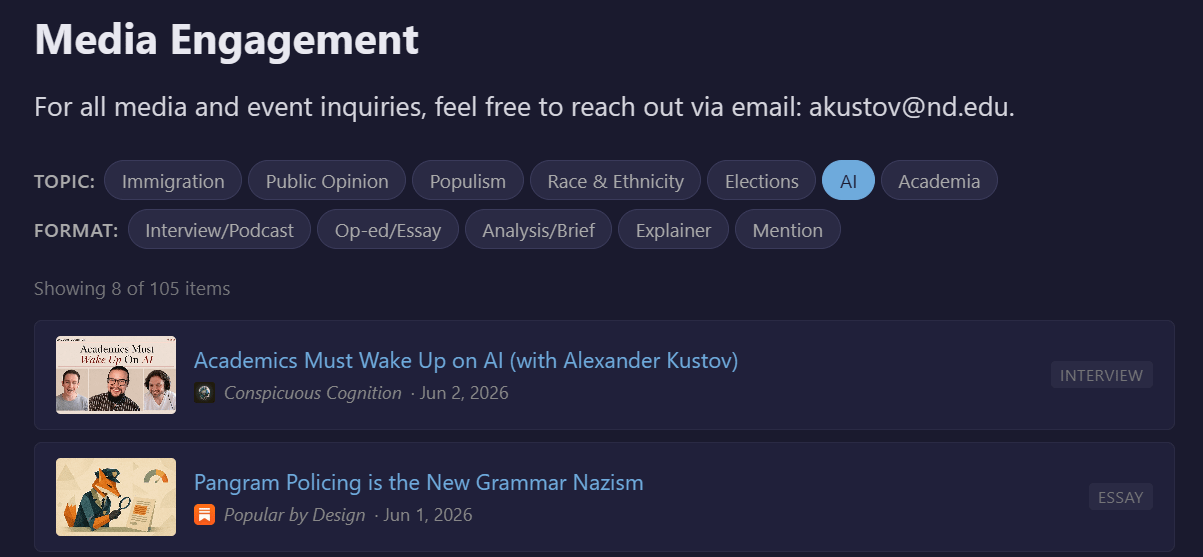
All the other possible add-ons you can think of, like publication highlights on the landing page or a sidebar of upcoming events, are possible—the limit is, as I keep saying again and again here, just your creativity. None of these would have justified hiring a web developer (especially on our meager academic budgets), but together, they make the site considerably more useful to a visiting journalist or colleague.
But my favorite new post-agentic addition is automatic website translation: alexanderkustov.org now exists in English and 11 other languages. It is not perfect, and it took me some time to set it all up by adjudicating based on translation into languages I speak myself, but it does the SEO job well enough. If a reporter in Germany, Mexico, or Japan googles something on immigration public opinion in their language, they may come across my research and reach out (which has already happened several times).

No grant or human translation agency was involved—my AI agent translated the site, and I now run an automated weekly check to compare the English pages with the 11 translations and list anything that has drifted out of sync. Even if I had initially hired certified human translators to do this job, I couldn’t afford to have them update their translations regularly (and I don’t ask people to work for free).4
What to do with research papers and ideas you already have
Once your research papers are published online, the AI agent can track what happens to them. We all know about Google Scholar—it tells you who cites your academic papers, but it can’t tell you who links to your public writing. So I made my own substitute out of Google Alerts on my name and major titles, a backlinks tool (e.g., with Ubersuggest), plus a scheduled scan that runs every Sunday morning and compiles new mentions and backlinks into one report I read with coffee.
A somewhat similar setup, it turns out, also helps with recording your research ideas and all the relevant writing across various platforms to help you develop those ideas. I have a whole backlog of things I come up with in the shower or during my conversations with colleagues, with one tracker for every idea and a scoring formula that includes subjective merit, expected involvement, and timeliness. When I stall, the agent tells me what to write next and suggests things to review on the topic from recent Substacks and academic journals I follow. You don’t have to do it exactly the same way, but I personally use Obsidian to organize and read all those markdown notes in one place while syncing it with my agent when necessary.
The same repository also lets me test ideas cheaply before committing to them. When I am unsure about a framing, I usually try it first as a social media post, and if it lands, I ask the agent to browse the responses and summarize the objections, which frequently become the counterarguments section of the eventual piece. Only after that does a pitch go out to an outlet, by which point I already know how the argument plays with a live audience.
Creating your own personal style guide and a writing skill
Once you have your website with all your ungated papers saved as PDFs and neatly available in one place, you should ask your AI agent to convert them to Markdown, extract each figure and table as its own file, and post all of it on the website next to the PDF. Believe it or not, the first reader of your paper is now often a machine; you want your work to be readable by AI so that AI can recommend that work to the human who prompted the relevant search.
You can also use the same clean .md (markdown) versions of your papers to create your “writing bank,” an authoritative truth about your thoughts for an agent to follow, which is very useful when you want to draft your new slides or a publicly accessible research summary. You can put everything you have ever written in this bank, saved as plain text (.md) files in one folder the agent can read: essays, op-eds, published papers, book chapters, even talk transcripts, with your voice already in that corpus.
You will also need a style guide of your own, because LLM writing is generic by default. Mine started as a single CLAUDE.md file and grew by accretion. I “trained” it on my own published pieces, corrected the first drafts it produced, then had it write the corrections down as rules. AI writing does have recognizable patterns, and by now my guide bans the tics everyone recognizes, including the “It’s not X, it’s Y” construction and artificially short paragraphs. The bans persist because these rules are stored in a file that the agent reads every time.
Over time, that one file grew into what Claude calls a skill, a small folder of instructions the agent loads whenever it writes as me; the diagram below shows the full setup. The writing bank feeds a voice profile (what I say and what I never say, down to sentence rhythm), while the style guide holds the rules. Before I see any draft, two checks run: a mechanical scan that flags banned constructions, and a fresh read by a second agent that sees only the final text plus the rulebook, because the agent that wrote a draft is blind to its own tics. My corrections then go back into the guide as new rules, which is the loop that makes the whole system improve.
The same agent can also serve as your reviewer, which may be the most underrated part of the setup. Before anything goes out, I ask for a critique of the draft from perspectives that are decidedly not mine: a restrictionist who thinks I am naive about enforcement, say, or a general reader who has never heard of “thermostatic opinion.” You can name specific writers whose judgment you trust, or simply describe ideological directions, and the notes that come back, while uneven, will reliably catch the objection I forgot to answer. For public writing, where no referee report is coming to save you, this kind of adversarial read is the closest substitute I have found.
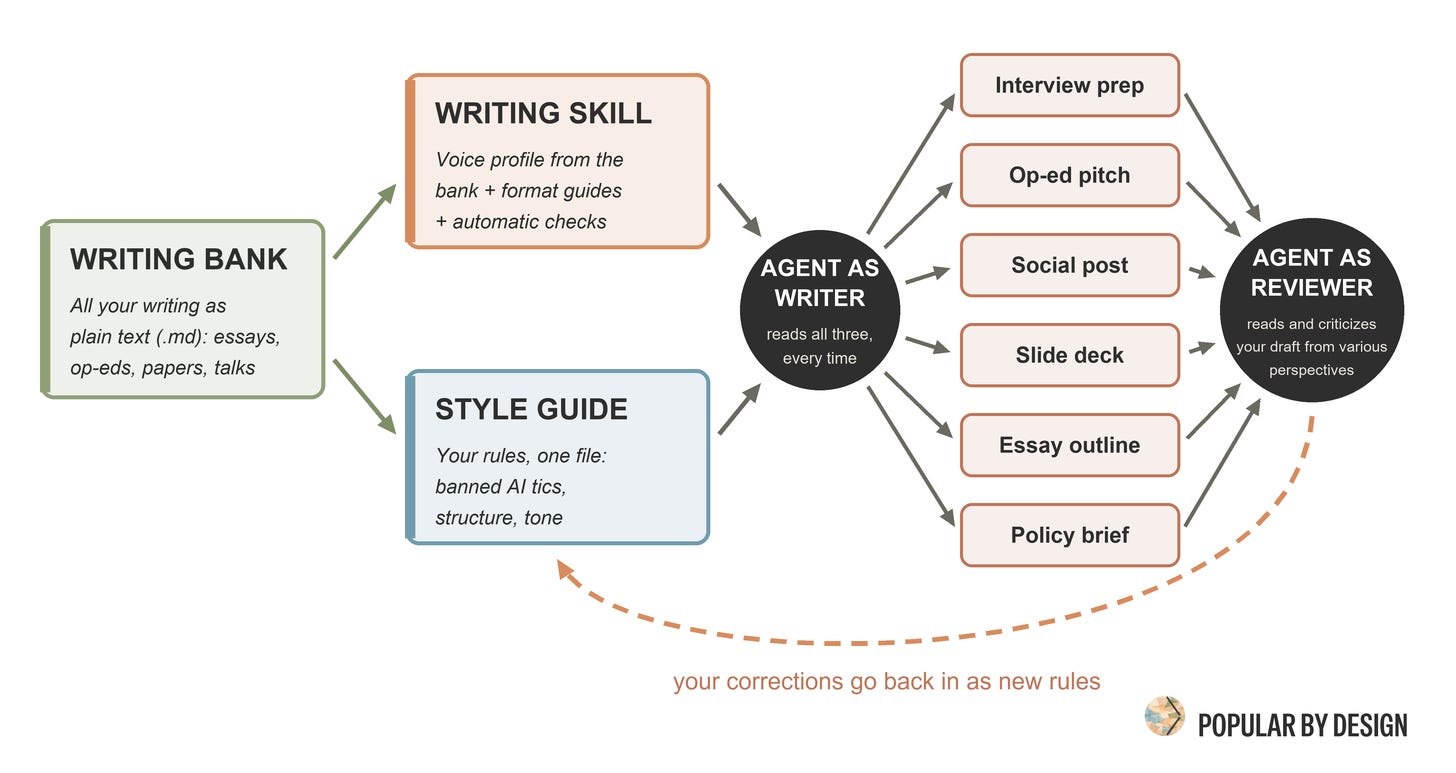
With those two pieces in place, you can ask for whatever you need from one finished paper: an interview prep document, an op-ed pitch, a social media post, a slide deck, a Substack article outline, or even, if you dare, a draft of a full-fledged policy brief. For my Machine Collaborations talk, I ran all of this on one of the most sadly under-read papers of mine, a 2020 study showing that majorities or pluralities in most of the 30 countries surveyed want both less immigration to and less emigration from their own country, and the run produced, among other things, three genuinely different framings for a future essay that I had not considered.
Or let’s say a journalist contacts you about a paper you wrote years ago to ask about its implications for current events. With such a setup, you can produce a good draft of what you can plausibly say, which is almost certainly going to be better and more accurate than what you could come up with on the spot.
What to do about slop and hallucinations
Whenever I describe this workflow to colleagues, the first worry I hear is that it will just produce more slop. Don’t get me wrong, plenty of one-shot AI-generated text deserves it (just like much of human writing). But everything in the setup described here starts from the presumption that you already have legitimate peer-reviewed research and edited popular writing. The agent is here merely to repackage or contextualize your own claims in a new light for your own human shitty first draft. Just like in the case of relying on overly enthusiastic human assistants, the responsibility for what goes out under your name remains with you. Whether the result reads as slop comes down to the verification, editing, and all the extra hard work you do before hitting publish.
That verification is not optional, because the models still make things up, and many now argue hallucination is the biggest bottleneck in AI-assisted research. I have learned this the hard way. My workflow once renamed my co-author, James Dennison, as “Mick Dennison,” a first name it invented outright even though the correct one was sitting in the very files it was working from. On other occasions, it attributed a parody account (@GovAmyKlobuchar) to the actual senator and handed me a LinkedIn URL guessed from the pattern of my name.
So what do I actually do? I have the model triple-check every name, date, reference, and link; I make it paste the output of its verification so I can see what it fetched; and then I verify the things that matter myself. Although this may be overkill, I also routinely ask Codex to verify what Claude Code did, and the other way around.
On the hallucination side, regarding references and their attributions, Steven Denney has written the best practical treatment I know of. Denney’s fix is what you would build for a fast but sloppy human research assistant. Reusable instructions check every citation against Crossref and the DOI, and a project folder keeps the original PDFs alongside the machine-readable versions so claims get checked against all original sources on hand with minimal possibility of error.
I should admit that, even with all these checks and all the newest models (I’m using Fable 5 and GPT 5.6), the system is not perfect. My Claude agent seems to love the rule of three so much, for instance, that it keeps adding triads to my drafts even though my own style guide explicitly bans them, and it kept doing it in this very piece after I asked it to stop, over and over again.
What does the future hold for scientific public engagement?
If all this leaves you wanting to try it, you can start by taking one of your finished papers and asking an agent to create an artifact, such as an interview prep, in your own style. You tweak the result until it sounds like you, save the instructions that got it there, so the next one is better and faster.
You may also notice that I deliberately did not include my own formal writing skill here. That is because it encodes my voice, and you, my dear reader, should develop yours. The simplest way to do that is to point your agent at this very post and ask it to implement the setup I describe, with whatever variations fit what you are trying to do.
What I’m describing will soon be the floor, rather than the ceiling, of agentic capability. For instance, political scientist Andy Hall at Stanford revealed this week that he plans to publish much of his original research directly on Substack. This rapid release will allow him to discuss and promote his latest research not only with other academics but also policymakers and journalists, allowing him to skip the “often arbitrary” comments from journal reviewers. He is upfront about the costs of skipping peer review, and it is clear that this option is easier for tenured folks and others with secure positions. For timely work, though, the calculation increasingly favors speed, and I already see more researchers—myself included—making the same choice.
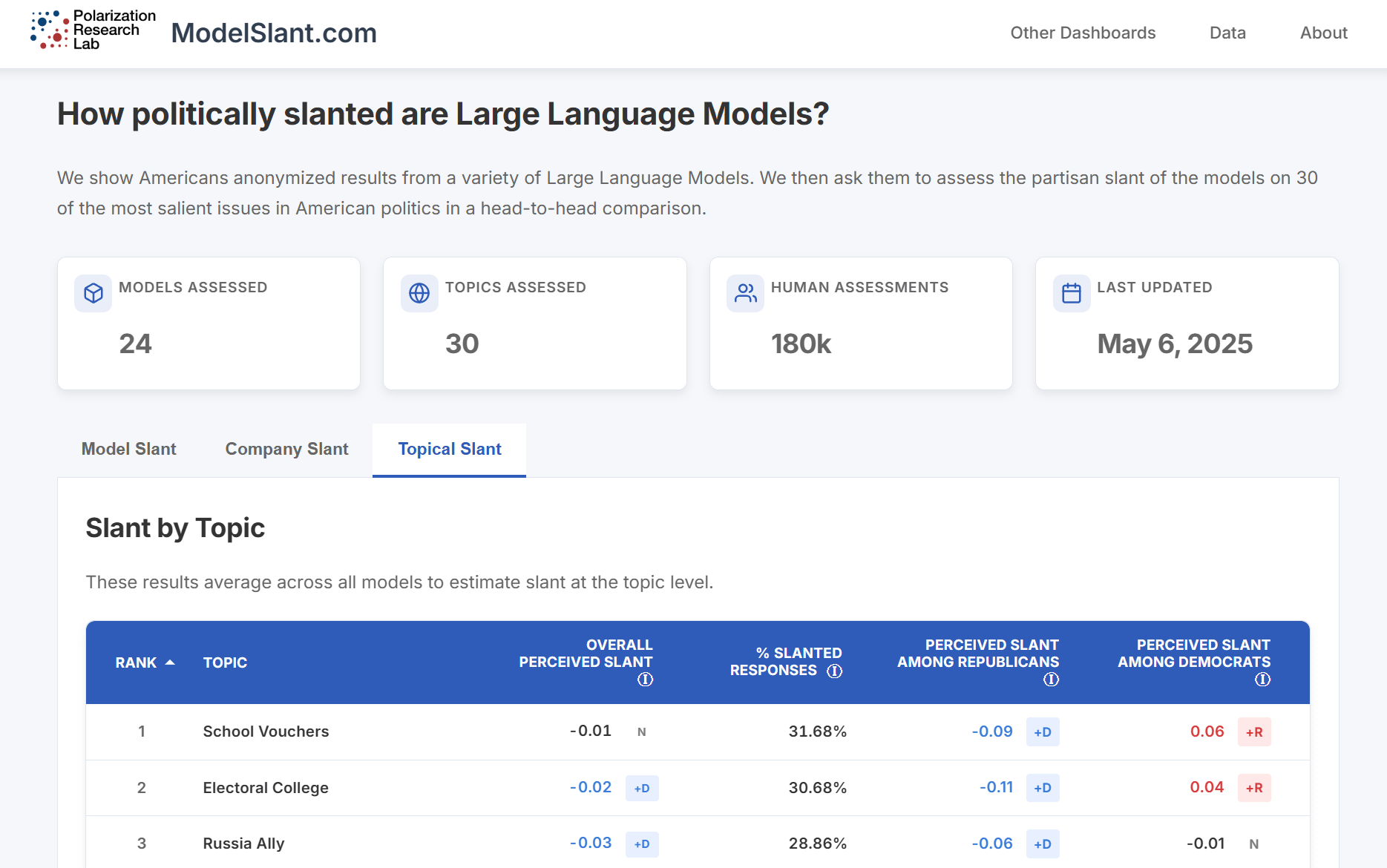
The frontier I find most exciting now is interactivity. Until recently, an interactive data feature was something only a newsroom with the resources of The New York Times could afford to build, while academic journals remain too outdated for anything more advanced than a static PNG. With an agent, any researcher can now publish an interactive companion to a published paper. Modelslant.com, the live companion that Sean Westwood, Justin Grimmer, and Andy Hall built for their working paper on the perceived political slant of AI models, lets readers explore the rankings themselves, and Hall’s lab now maintains a whole shelf of similar prototypes. Nothing about this, however, necessarily requires the resources of a Stanford lab anymore, and your own under-read paper is exactly the kind of candidate such a companion was made for.
The kicker of my first AI post still holds: lock yourself in a room with Claude Code and one tedious public engagement or research task you never had time to do, and see what happens. The specific tools in this guide will possibly look dated within a year, but the underlying shift is not going anywhere. The marginal cost of serious public writing has collapsed, and researchers who stay silent now cede the conversation to writers with worse information. You may not like AI or AI-assisted writing yet, but if you have something worth saying, staying silent while not using the best tools available is an active choice you’re making.
Huge thanks to Mike Riggs, Jannik Reigl, Jeff Fong, and, of course, Claude and Codex for their helpful suggestions on the draft.
And if you are lucky enough to have an actual human assistant, the same principle applies one level down: empower them to outsource this kind of work to their own AI agent, so their time goes to the parts of the job they do best or actually signed up to learn.
I'm happy to concede I basically lost my case given the latest developments on integrating Pangram into Substack. I want to believe that my writing, alongside many others, was able to nudge that integration into a more productive direction (as an opt-in feature with no retroactive force, and transparently available to both readers and writers).
My sense is that, with some effort, many academics should be able to use their research budgets, department funds, university subscriptions, and AI companies' own research programs to pay for those outside of their own pocket.
One practical caveat here, though, is that machine translation of social science goes wrong precisely at the key terms. So I keep a pinned glossary file that ensures “backlash” is always reacción in Spanish and reazione in Italian, and that “thermostatic” is always termostático.
A very pragmatic guide addressing many points that are not evident when heading in this direction. I can see parallele with my own evolving approach but unfortunately think that the clarity you bring won't be realised without experiencing a few knocks along the way. Well said, Alex.
Interesting piece and quite enjoyed it. I especially like the idea of auto-translated websites. I used to have a github pages but recently replaced with a Carrd landing page. But now I'm re-thinking. Many thanks.
A few follow up questions come to mind about other parts of the piece.
1. You start with a style guide and let it evolve after you make edits. What's a basic one look like? I get why you don't share yours, because then that would color everyone else's. I presume I could start with something like a crib sheet from Chicago, MLA, or whatever, add rules from Strunk & White, and then include any unique things for me (say, "always 'policy-maker' not 'policymaker'" or the other way around depending on each person's style guide). But how long should that first one be, and then how do I decide which edits need to be moved back into the styleguide and which are just one-offs that can be left alone? What else is missing here?
2. I have github and use it sporadically. How does the agent work with github? Is it reading the repo or is it reading the version control from the `.git`files in a folder?
3. Speaking of agents. I'm not sure I follow. Is this the same thing as having the desktop version of the AI or something that each scholar builds for himself?
4. Relatedly, what's your recommendation for scholars who use university issued computers that prohibit agents on their machines? My university laptop is extremely locked down. All software has to be approved through a workday ticket. Many requests are often denied for "security" reasons (read: the university IT dept doesn't want to deal with it at scale). As a result, I have a workflow that relies on my MacBook Neo for all writing and custom software, I use my work issued MacBook Pro for quant work. It's cumbersome but works. I suspect others might only have their work laptop and cannot use an agent or desktop versions.