


I have a new essay in Foreign Affairs (paywall-free gift link): no democracy has ever eased widespread immigration concerns without being very selective about whom it admits. To move forward on the issue, governments on the left and right should make better policies whose benefits to voters are clear.
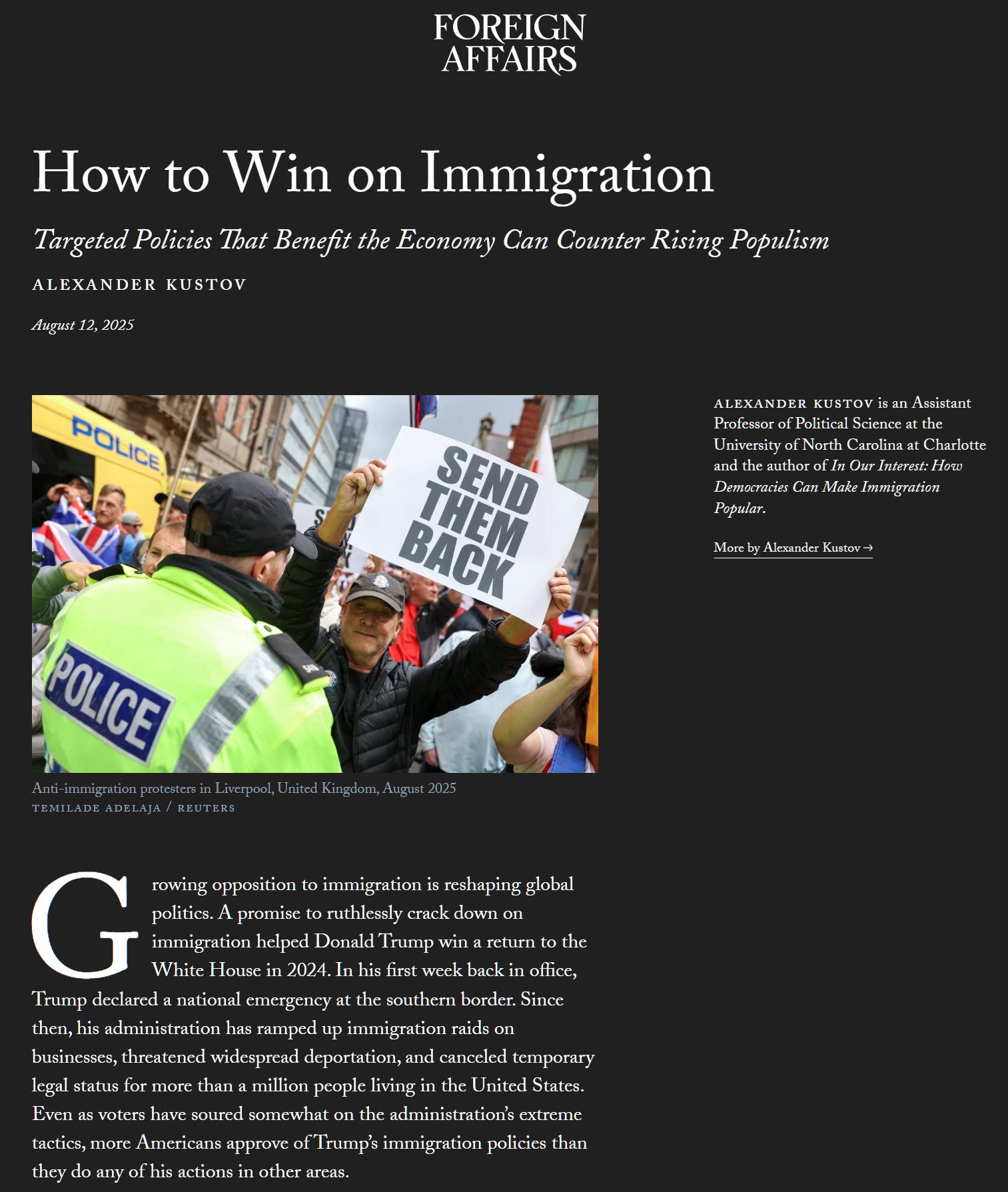
One common concern I hear is that making better policy is futile in a world where populists can demonize immigrants and spread misinformation. I don’t think that’s right, so I address it in the piece:
Some politicians will always seek to exploit immigration anxieties, exaggerate problems, and spread misinformation. But it is easier to do in Sweden than in Canada. This isn’t because Canadians are more tolerant, nor is it because their leaders have found the perfect communication strategy to sway the population. Rather, it’s because voters can see that Canadian immigration policies work. The more that democratic governments take public concerns seriously and craft immigration policies that clearly benefit society in ways people can understand, the less space there is for xenophobic populists to claim that only they have the country’s interests at heart.
Responsible democratic governments serious about making immigration politically viable must also be willing to compromise. Immigration debates are often framed in binary terms—open versus closed, pro-immigration versus anti-immigration, nationalist versus cosmopolitan. But real solutions lie in which types of immigration policies countries pursue. Work-oriented policies, rather than humanitarian-based ones, are more likely to command broad support. Sweden has finally begun moving in this direction by introducing more selective immigration criteria. Inspired by Canada, Germany has also adopted its own version of a points-based immigration system; in 2024, the country issued ten percent more skilled worker visas than the year prior.
I had a great experience working with my editor at Foreign Affairs, but we did have to cut quite a bit, including references and links (which they no longer include as a matter of policy). I’ll post an expanded, fully sourced version here soon. In the meantime, please check out the whole piece and stay tuned for more!
Hi Alexander, thanks for the piece! I liked it and agree with most of what you write! In one point I disagree though and I thought it may be worthwhile highlighting this:
A number of studies and polls indicate that people actually have no problem with admitting people for humanitarian, as opposed to economic, reasons. Take, for example, the study by Czymara & Schmitdt-Catran 2017, where they find that respondents are significantly more willing to admit people fleeing persecution over people arriving for economic reasons - even if economic migrants already have a job secured and are therefore likely to contribute more to the economy.
The problem with humanitarian immigration appears to be much more the close association with irregular immigration. The latter is what most people - even many who are open to immigration in general - disapprove of and what gives them the impression of being exploited. This recent Ipsos poll shows that large majorities are in favor of granting refugees protection in principle - but believe that Most "foreigners who want to get into my country as a
refugee really aren't refugees". https://www.ipsos.com/sites/default/files/ct/news/documents/2024-06/Ipsos-World-Refugee-Day-2024-Global-Report-PUBLIC_0.pdf). In my own research I elaborate this point more in depth and find a widespread openness for refugee immigration through orderly pathways (https://unu.edu/merit/article/reforms-welcome-where-germans-agree-refugee-and-asylum-migration).
A recent study even suggests that humanitarian arguments are more likely to win over people for admitting refugees than utilitarian arguments are (https://journals.sagepub.com/doi/10.1177/01979183251353452).
To conclude: I believe the key reason that immigration is more popular in Canada than in Sweden is that humanitarian immigration in Canada is largely based on orderly refugee resettlement - rather than irregular asylum immigration.
Curious to hear your (or others') thoughts on this.
Best,
Tobias
Totally agree with your piece! Proponents of immigration often frame letting in newcomers as an act of compassion or a commitment to universal values, but have neglected to highlight the benefits of immigration to native born citizens.