


I have a new essay in The Atlantic (not my title) arguing that the norm of opposing "only" illegal immigration was insincere—but also useful, and now it’s gone.
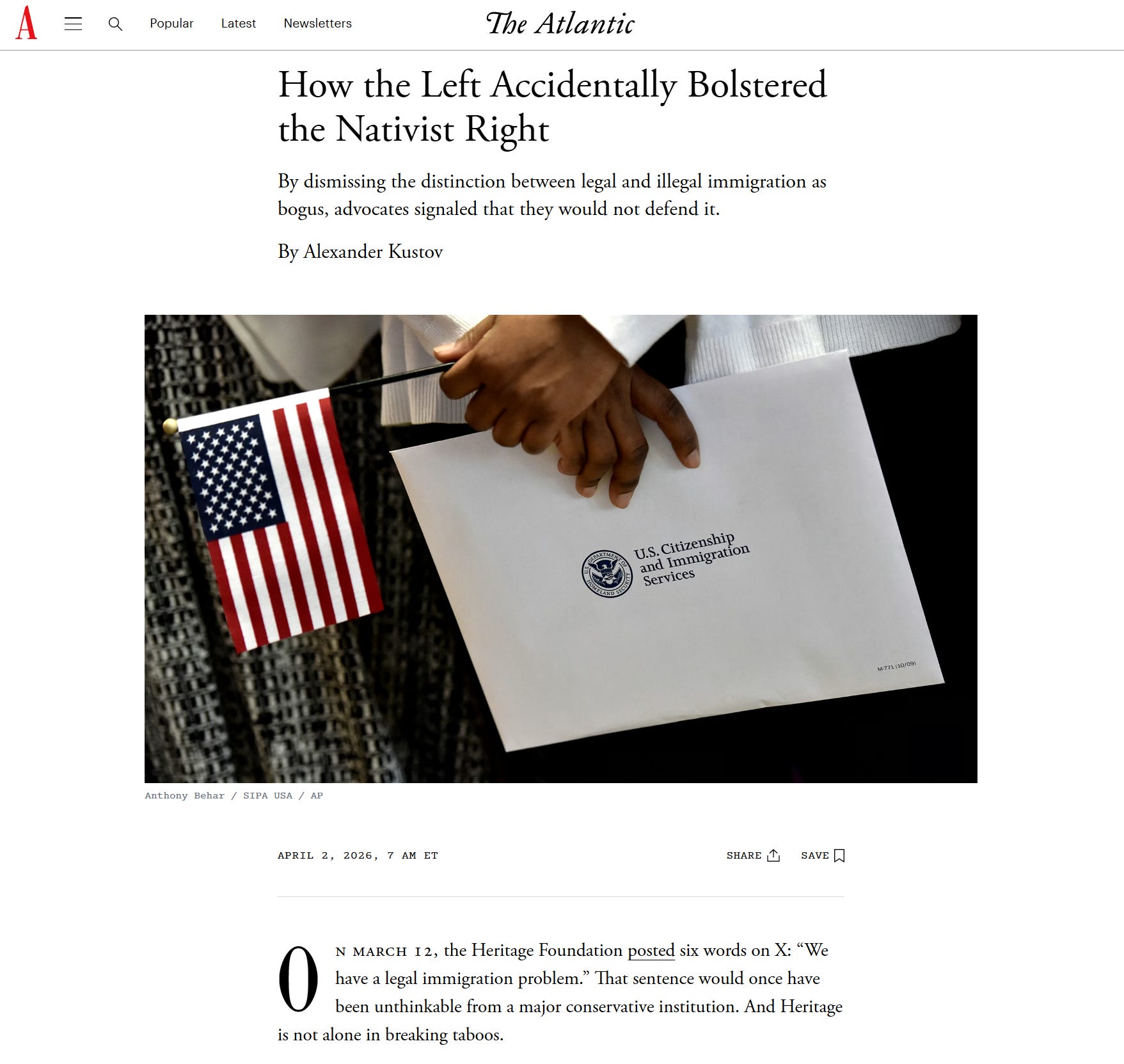
Here’s where I think the argument turns:
Many of my academic colleagues felt differently, however. To them, “I just oppose illegal immigration” was a socially acceptable way to express opposition to foreigners in general—xenophobia dressed in procedural language. I have been guilty of dismissing popular attitudes myself; when giving lectures about, say, the H-1B visa backlog or refugee processing times, I have found myself exasperated by audience members who stand up to ask why I haven’t gone out of my way to condemn illegal immigration.
Over the years, many scholars and advocates thus came to see the distinction as illegitimate. For some, the American immigration system is already so unfair and restrictive—fewer than 1 percent of people who want to immigrate can do so legally—that saying “Just follow the rules” can feel cruel. Others go further: Unauthorized border crossing is a victimless regulatory violation, they argue, and any law restricting people’s free movement is unjust.
I now think this dismissal was a mistake. The norm was imperfect and often insincere—but it was holding something together. Now that it’s gone, I’ll try to be a little less annoyed the next time someone in my audience stands up to ask why I haven’t condemned illegal immigration. Turns out that was the good version of the conversation after all. Read the full piece here (archive link).
Thank you for writing this article. I am nervous about writing this since after all you've done real research on US public opinion on immigration, as opposed to most pundits in this space.
If I understand your argument correctly, you are saying that because immigration advocates tended to equate opposition to illegal and legal immigration, they were unprepared for even the first Trump administration's attacks on the legal variety, and this allowed the _right_ to march into opposing them both.
In the first place, I'm not even sure one can argue that legal immigration was ever all that popular. The H-1B visa program has long been unpopular, as much among the left as right - Bernie Sanders famously criticized it. I don't think the data supports the charge it suppresses wages. I myself was on an H-1B (alternating with TN-1) from 2000-10, and some of the salaries I earned during that period were among the highest I ever had.
Morever, iirc current legal immigration were set in 1990 legislation and have never been altered since then. I don't even think a presidential candidate has even campaigned on raising them, but as far back as 1996 Pat Buchanan called for a 5-year moratorium. The impression I get is that, while most media attention goes on illegal immigration, there has always been sections of conservative media that want to cut legal too, across the board, even in the 1990s. On the left, most advocacy was for more lenient treatment of the undocumented or expanded family reunification. The business lobby wanted more temporary visas like H-1B, often pushing for its expansion in boom periods. No one seemed to argue for more skilled worker visas at all. This wouldn't have been the case if legal immigration was popular. The US barely takes more skilled workers than Canada. And this is basically why I left the US in 2010, it was too difficult to get a green card.
Now what you write about the hard right uncovering extreme opinions and normalizing them does make sense. But I don't see how that follows from the left conflating the legal/illegal distinction.
The idea that legal immigration could have been successfully defended by making a stand against illegal doesn't quite square with the record. Consider the 2007 comprehensive immigration reform bill. It had an amnesty, which the right opposed. But it also replaced family reunification with more skilled workers - basically what Canada did in 1995. The left opposed that. The skilled workers would have been allowed to apply based on points alone, as in Canada, and not require employer sponsorship - and the business lobby opposed that.
So the bill failed, in a Democratic Congress, even though the Bush administration had indicated it would sign it. This was indeed the left's fault, but not quite in the way you suggest.
Canada's 1995 reforms have been shown to have completely turned around public opinion, from being largely negative to largely positive. Something similar could have happened in the US had the 2007 bill passed.
Can't read the article yet, but I already have an take from an different angle considering illegality.
First of all, yes, most of the time, saying to oppose illegal immigration is usually a big nothing burger, because we implicitly want illegal stuff to be stopped. It essentially "Stuff that shouldn't happen shouldn't happen".
Therefore, what the public should discuss is "what should be illegal in the first place?".
However, this isn't as straight forward as it sounds, because it's not just a question of how would theoretically optimal behavior look like, but also the capabilities of the state to enforce this behavior.
I discussed this already in the context of drugs like cocaine and my argument is essentially that if the means to do a certain behavior you want to prohibit are too open ended, then you essentially have no chance of preventing the behavior from actually happening, leaning to a situation where it still happens despite its illegality.
In the migration system, the biggest vulnerability are by far temporary entrances becoming permanent, because there is no way to ensure that someone who entered the country does also leave it after a certain time unless you utilize draconian surveillance systems.
This alone makes it de facto not possible to control migration the way some people want to. No wall will stop that, and any measure that would will likely either be unreasonably expensive (remember that enforcement will inevitably cost workforce) or something from a totalitarian state.
I could go on how to handle, for example, the undocumented migrants who are here to work in agriculture, but for now I would leave it at that.
As a last thing, I personally dispise any form of meta discussions along the lines of "why advocating for x will strengthen the y", because I wanna be fundermentally, Ehm, "Sachorientiert" and not think in terms of mass manipulation.
But that is also a topic for another essay.