


The images from Ceuta were everywhere this summer, and the obvious question is how long Spain's quiet immigration politics can last. Today's guest essay by Alejandro Iribas, a Spanish economist who writes and hosts at Money & Macro, explains the system behind that eerie calm and why the country running Europe's biggest immigration boom has produced so little backlash, at least so far. Enjoy!
Few people realize this, but over the past five years, Spain has absorbed more than five million immigrants, adding the equivalent of 2% to its total population every single year. Across OECD countries, only Germany came close to these numbers, and even there, annual inflows seem to have cooled off. Yet the political reaction has been mostly absent: the country running Europe’s largest immigration experiment has one of its weakest far-right parties, and until this year most Spaniards barely ranked immigration as a national concern. This essay is my attempt to explain that exception, and to ask whether it can survive. I argue that Spain’s relative calm owes much to who its immigrants are and to a political system in which other conflicts have kept immigration from becoming the main divide.
While the Spanish government continues to reaffirm its commitment to a migration policy grounded in “solvency, humanity, and efficiency,” a closer look at the landscape raises more than a few eyebrows:
Most immigrants in Spain are relatively poor, earning around 29% less than the average local worker- one of the biggest gaps in the OECD;
40% lack a high school diploma and only one in four migrants have some tertiary education, one of the lowest shares in the EU;1
In the last seven years, the country recorded over 150,000 irregular boat crossings to the Canary Islands and experienced 2 major border surges in its North African enclave, Ceuta, with the last one overwhelming the city with around 80,000 entries, almost the size of the city’s population;
In light of the recent growth in the undocumented population, the government has recently implemented a general regularization that received over 1 million applications of foreigners that were residing in Spain without proper documentation.
On paper, this is hardly a policy model you would pitch at an international conference. When voters feel their government has lost control over who enters and who stays—or question whether the system serves the national interest—they can get pretty anxious. This is precisely the environment where right-wing populism thrives, leveraging concerns around crime, fiscal strain, and deservingness.
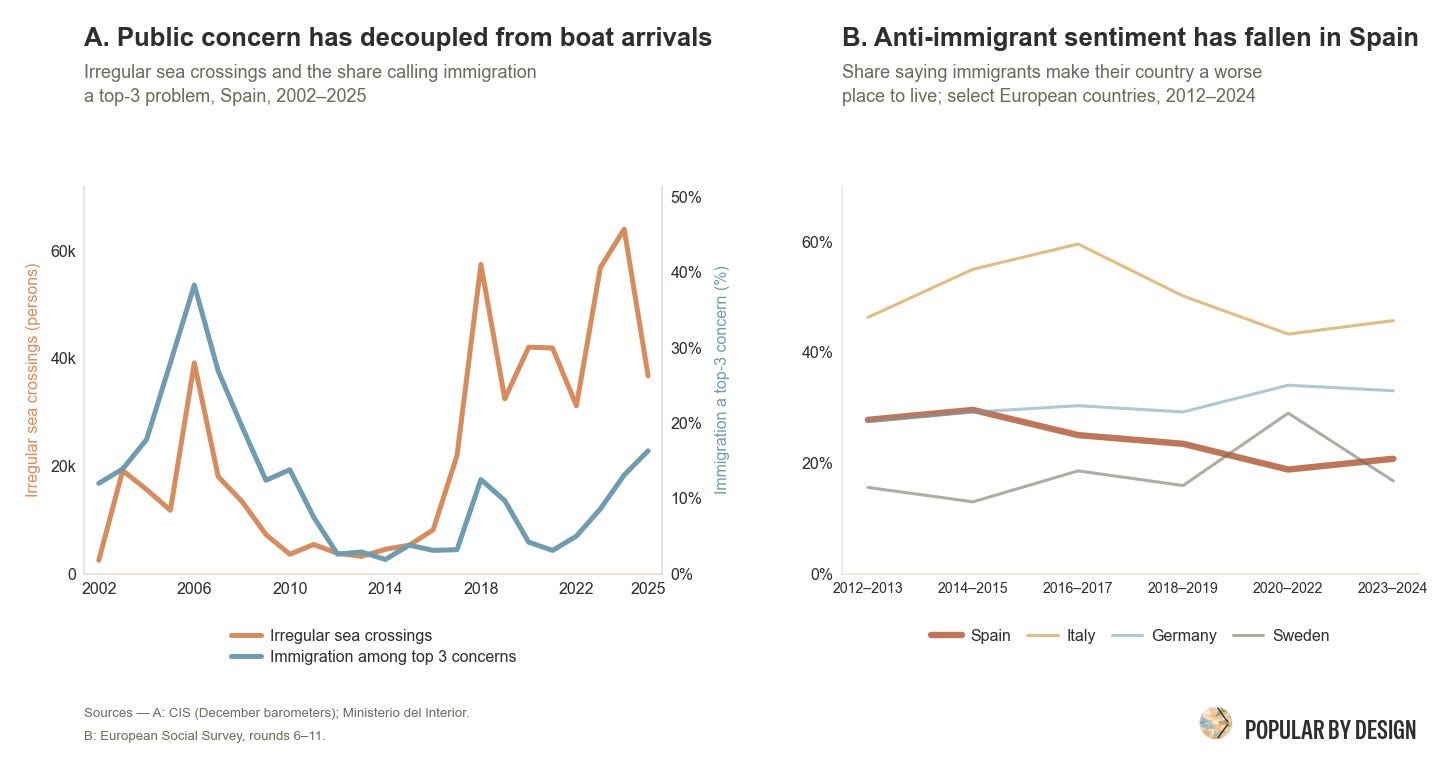
With far-right parties like the AfD in Germany now getting over 40% support in some polls, Germans seem to be quietly learning the lesson that while humanitarian goals matter, voters ultimately want migration policy to align with national interests. Yet in Spain’s 2023 general election—held amidst ongoing relocations of asylum seekers from the islands to the mainland—Pedro Sánchez’s left-wing coalition retained power, while the populist-right party VOX failed to surpass its 15% vote share from 2019, landing at 12.4%. By the end of that year, only 8.6% of Spaniards named immigration as a top national concern. Now that number has risen to 23%, making immigration the second highest concern for Spaniards according to July CIS Barometer surveys, though still well below the housing affordability crisis. Meanwhile, VOX’s polling momentum remains capped at around 17%, far below the heights reached by its European peers.
So, why is Spain different? Why so little backlash? To answer these questions properly, I think it’s important to know a little about the history of immigration in Spain.
The rise, the fall and the resurgence of immigration
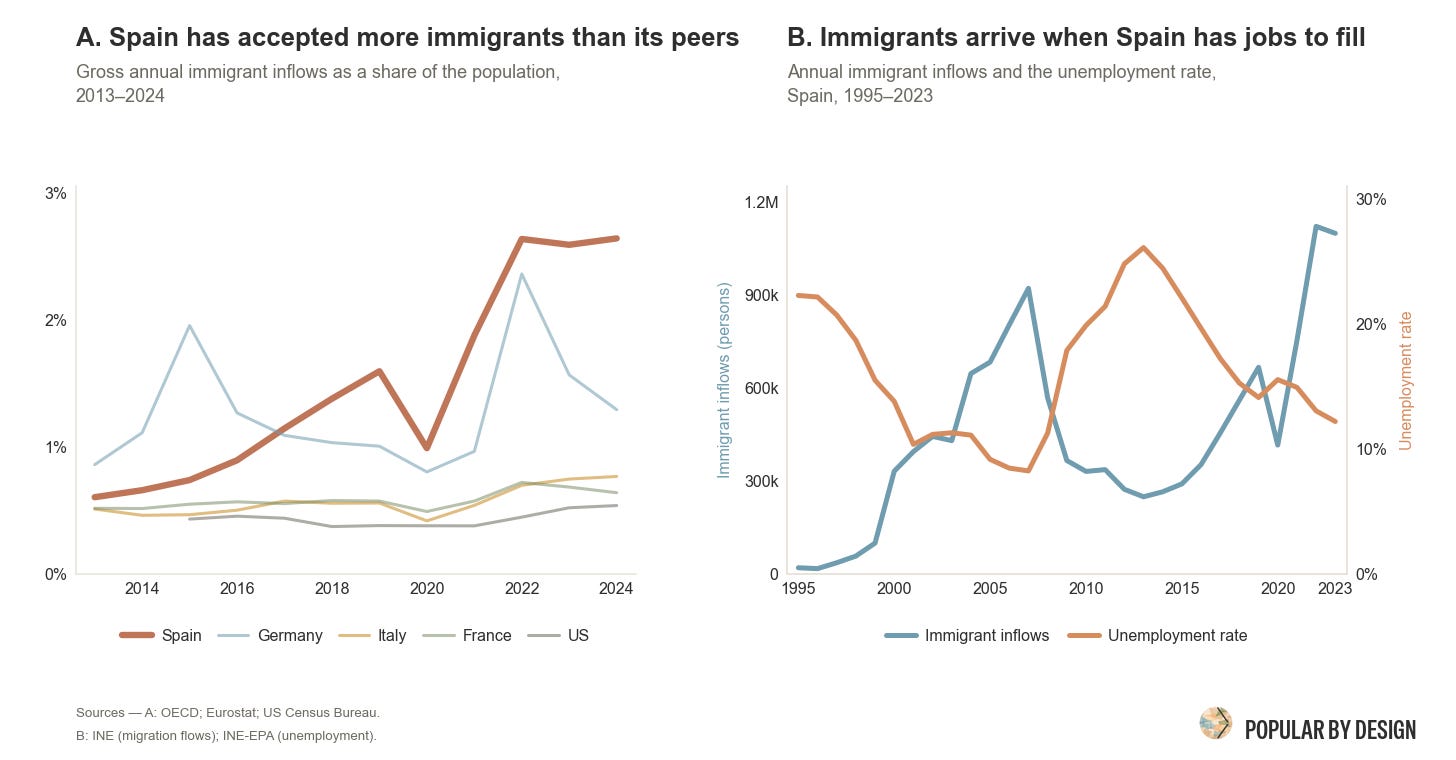
The history of Spanish immigration is a story of two massive booms separated by a deep economic recession. Unlike other European powers that built guest-worker programs after WWII, Spain had virtually no foreign-born population a generation ago; my parents didn’t know a single immigrant growing up.
In the first boom, Spain’s foreign-born population skyrocketed from 2% in 1997 to over 10% in just ten years. Today, in its second boom, Spain is once again leading Europe in total and relative inflows. While distinct in certain ways, both booms were driven by a recurring formula, a specific mix of three ingredients that serves as the blueprint for the Spanish model.
A) Labor demand. Immigrant inflows in Spain closely track the unemployment rate. Spanish economic growth relies heavily on construction, hospitality, and personal care. The companies operating in these sectors are typically small, labor-intensive and quick to hire and fire, and are often willing to work informally. This creates an ideal structure for absorbing large numbers of workers rapidly, even if they lack high formal education or valid work permits.
The first boom was dominated by construction, alongside significant numbers in agriculture, hospitality, and a fast-growing domestic care sector. By the peak of that boom in 2007, the top countries of origin were Romania, Morocco, and Ecuador. The second boom has been driven primarily by hospitality and services, with Latin Americans making up the majority of new arrivals.
B) Visa policy. The steady demand for low-skilled labor is a feature of the Spanish business cycle, but it could never have produced over eight million foreign-born residents without accessible pathways into the country. Unlike the post-war guest worker programs enacted in other European countries, the Spanish immigration booms were not the result of an intentional recruitment program aimed at addressing any particular problem with the Spanish economy, but a combination of lax visa policies and the expectation of access to legal status after an irregular arrival.
During the first boom, citizens of several Latin American countries could travel to Spain with just a passport, thanks to long-standing bilateral visa exemptions that had been folded into Schengen regulations. Romanians gained similar visa-free travel access starting in 2002, and later became the largest immigrant community in the country. We know visa waivers fueled this surge because when Spain selectively got rid of them—for Colombia in 2001, Ecuador in 2003, and Bolivia in 2006—inflows plummeted almost overnight.
Overstaying short-term visas remained the primary route into the country in the early 2000s, causing the undocumented population to build up rapidly. To manage this reality, governments of both left and right ran four extraordinary regularizations, granting work and residence permits to over one million immigrants between 2000 and 2005. While these amnesties allowed migrants to contribute to the welfare state and move into better jobs, relying on periodic amnesties as a primary policy tool was widely criticized as arbitrary and politically volatile. Seeking a more durable mechanism, the socialist government introduced arraigo in 2005: an ongoing, individual pathway that allows migrants to apply for legal status after 1 to 3 years of continuous residency, provided they have no criminal record. Shortly thereafter, however, the 2008 financial crisis brought inflows to a sudden halt.
The second boom echoes many of these policy choices. It was kicked off by Schengen visa exemptions for Colombia and Peru in 2015 and 2016, which more than doubled arrivals from those nations over the following decade.
Once again, a new generation of overstayers turned to arraigo as their main gateway to formal work permits. Yet the sheer volume of recent arrivals has proven so big that even a flexible, uncapped mechanism like arraigo has been overwhelmed, driving a rapid rise in the undocumented population. To break the gridlock, this year the government stepped in with a controversial general amnesty that has registered over one million applications. Unsurprisingly, Colombian nationals represent by far the largest demographic applying for relief, a direct footprint of the 2015 visa exemptions coming full circle.
C) Push factors: When jobs are readily available and entry is straightforward, the economic incentive to move is set. But sometimes sharp domestic crisis at origin can push thousands to take the leap who might otherwise have stayed put or migrated elsewhere.
During the first boom, key external triggers included the severe 1990s Ecuadorian economic crisis and post-9/11 border tightening in the United States, which redirected migrant flows toward Spain. During the second boom, the defining shock was the catastrophic economic collapse of Venezuela. This exodus has driven Venezuelans to become the third-largest foreign community in Spain, behind only Colombians and Moroccans. This second Spanish immigration boom carries a distinctly more Latin American flavor, yet it retains all the core hallmarks of the first: it is largely unplanned, relies heavily on low-wage labor, absorbs a high proportion of undocumented workers, and frequently misallocates human talent.
As regular readers of this blog know, rapid influx of low skilled and undocumented foreigners are hardly ever popular among voters. Which brings us to the next obvious question.
Why so little backlash?
Spain was a latecomer to Europe’s populist-right wave, a fact that has sparked some speculation. One prominent argument centers around the post-Franco political culture that emerged in the late 1970s and 1980s: coming out of the long shadow of a 36-year dictatorship, the generation of my parents was raised to idealize democratic, egalitarian, and universalist values, creating a deep social stigma around rhetoric that echoed 20th-century authoritarianism. Under this view, this historical legacy imposed higher cultural barriers for parties like VOX to overcome. Tellingly, neighboring Portugal (which also emerged from a military dictatorship in the mid-1970s) was also a latecomer to Europe’s populist-right wave.
Beyond cultural taboos, geography and party politics likely played crucial roles. Neither Spain nor Portugal stood on the front lines of the 2015 Syrian refugee crisis. In other European countries, that crisis catapulted immigration to the center of the political stage, handing the far right a potent weapon against the ruling establishment. This mechanism simply failed to trigger in Spain and Portugal, where inflows had dried up after the 2008 crisis, and over 20% unemployment seemed like a bigger thing to worry about at the time. Additionally, in the midst of Spain’s economic crisis, public anger was initially captured by new challenger parties on the left and center. Rather than targeting migrants, these movements successfully channeled voter discontent toward political elites, potentially delaying the space for a right-wing populist breakthrough.
This Spanish exceptionalism appeared to dissolve in 2019 when VOX surged from obscurity to secure 15% of the national vote. Were Spaniards finally waking up to the immigrant threat their European peers had been shouting about for years? Not really. Granular voter analysis reveals that immigration attitudes were a surprisingly weak predictor of early VOX support compared to opposition to the Catalan independence movement.
Since then, VOX’s discourse has turned markedly more anti-immigrant, coinciding with the peak of the second immigration boom and record numbers of irregular boat arrivals in the Canary Islands. At this point, many would have predicted that immigration would finally become a politically defining issue. Instead, two things seem to go in the opposite direction:
The public salience of immigration has decoupled from irregular arrivals. Historically, voters react strongly to maritime crossings, as images of unmonitored boat arrivals generate a perception of chaos and loss of control. During Spain’s 2006 Cayucos crisis (when around 40,000 migrants reached the Canary Islands) immigration briefly soared to become the public’s single greatest concern. Over the past decade, however, despite a larger, more prolonged humanitarian crisis and relentless anti-immigrant messaging on social media, few Spaniards consistently rank immigration among their top three concerns.2
Negative attitudes toward immigration have declined rather than escalated. As VOX normalized far-right rhetoric, one would expect the reputational costs of expressing anti-immigrant views would decline. Yet, negative attitudes toward immigration have remained surprisingly contained. According to the latest wave of the European Social Survey (ESS), roughly one-quarter of Spaniards believe that immigration makes their country a worse place to live. That share is not only significantly lower than in countries like Italy or Germany, but it has somewhat trended downward alongside the rise of VOX and the start of the second immigration boom.
How do we make sense of all this? Whatever some of my international progressive friends like to imagine after hearing Pedro Sánchez challenge Trump’s approach to immigration, I don’t think my fellow Spaniards are more cosmopolitan or better informed than other Europeans.
Instead, I think there might be two distinct features about the Spanish immigration experience that could prevent immigration from becoming the top concern despite the high shares of undocumented and low-skilled.
New immigrants mainly come from Latin America, a region that shares a language and deep cultural ties with Spain. If you live in any major Spanish city, Latin Americans are a seamless part of daily life, whether as friends, coworkers, or service providers. Unsurprisingly, anti-immigrant animosity toward this group remains extremely low. It is very hard to think that Spain could have accepted such large influx had it come primarily from majority-Muslim countries.
Immigrants in Spain are relatively young. Immigration is a relatively recent phenomenon in Spain, and immigrants from the first boom are still for the most part of working age. Even though most immigrants earn below-average wages, the Spanish welfare state primarily redistributes through its pension system (72% of post-tax redistribution), with comparatively little provision for poor families and almost no public housing. There is simply less to fight over than in the northern countries, where a more generous welfare state makes newcomers look like rivals for benefits, family support, and social housing. As the Spanish government likes to remind, immigrants currently generate around 10% of Social Security revenue while drawing just 1% of its spending.
This makeup of Spain’s immigrant population pushes Spanish politics in two different directions. For the ruling Socialist (PSOE) government, foreign workers provide nice GDP and job creation figures and the tax revenue needed to delay unpopular reforms to the pension system. At the same time, Prime Minister Pedro Sánchez has mastered the art of weaponizing global issues like immigration, the war in Gaza and military spending to pick fights with polarizing figures like Donald Trump or Elon Musk. By linking domestic right-wing parties to Trumpist rhetoric, Sánchez transforms immigration into a high-stakes moral battle, framing support for his migration policy as a direct test of democratic values.
With VOX bringing anti-immigrant rhetoric into mainstream politics, left-wing voters could have reacted by adopting even more liberal views on migration out of the fear of sounding like them. As Sebastian Rinken notes, the recent decline in negative attitudes towards immigrants is driven almost entirely by left-wing respondents.3
You might expect VOX to make left-wing voters even more hesitant to speak out against immigration, while making right-wing voters feel freer to do so. Yet the share of right-leaning Spaniards who think immigration harms the country has held steady at around 35% for 15 years.
This highlights the second way the demographic profile of the immigrant population influences party politics. Because most recent arrivals come from Latin America, right-wing parties find it difficult to make broad anti-immigrant arguments. Certain Latin American groups, such as Venezuelans, hold pretty negative views on socialist policies, and have actually become reliable supporters of the Spanish right. As a result, VOX has to narrowly target its anti-immigrant rhetoric against African arrivals, a group that makes up a shrinking share of the overall migrant population.
So far, this unique alignment of party competition and immigrant demographics may have functioned as a political buffer, allowing Spain to defy the conventional wisdom seen across Europe and absorb significant numbers of low-skilled and undocumented immigrants without triggering a broad anti-immigrant backlash. Yet as immigration climbs higher on the list of voter concerns, that political immunity may be wearing thin.
Can the Ceuta surge be a breaking point?
Images of thousands of young Moroccans milling along the beaches of Ceuta have traveled the world—a vivid snapshot of border policy breakdown, accompanied by mounting anger and a sense of abandonment from local residents.
The surge occurred just three weeks after a landmark Supreme Court ruling restricted police from performing immediate pushbacks of migrants trying to reach Spain by sea. The legal saga began when an Algerian citizen—who had attempted to swim around Tarajal beach—sued the Spanish government after being sent back to Moroccan soil without the right of a court hearing. He argued that the 2015 Citizen Security Law authorizing “summary returns” (rechazos en frontera) applied strictly to land borders, not maritime arrivals.
Following a series of appeals, the Supreme Court ultimately ruled in his favor. The justices highlighted that the text of the law explicitly restricted fast removals to migrants trying to “cross border control elements”, reasoning that open waters do not qualify as a border fence or barrier.
Most people never hear about a ruling like that, but these things can spread fast in social media groups, and usually in a distorted version. Unfortunately, it is possible that a distorted version of a ruling is enough to convince thousands of disenfranchised young Moroccans that the border is open and mobilize them to coordinate a crossing attempt.
Group attempts at the border are nothing new, and Spain depends on coordination with Moroccan police and intelligence to break them up before they build. Given the scale of this attempt, it is hard to believe Moroccan security missed it entirely. Suspicion of an intentional “blind eye” is perfectly justified. After all, in 2021, Moroccan guards famously opened the gates to over 5,000 migrants during a diplomatic spat. Still, the geopolitical returns for Rabat aren’t obvious this time around, at least to me, so I’d hesitate to draw firm conclusions just yet.
Whatever the truth of the matter, the past few weeks have brought intense commentary on the fragility of Spain’s border and on what the relationship with Morocco ought to look like. But once the last crossers are returned and Ceuta settles back into normality, the question is how long before the media cycle moves on, before attention snaps back to partisan bickering and corruption scandals, and border policy fades into the background again.
The beginning of the end of the Spanish exception?
The high degree of cultural proximity among Spain’s immigrant population may have acted as a political buffer, blunting the sharpest edges of anti-immigrant sentiment. However, repeated humanitarian crises on maritime and land borders are slowly making immigration escalate in the list of concerns. While VOX vote intention seems to remain capped at a relatively low ceiling, events like Ceuta risk deepening the loss of legitimacy of the Spanish model, calling for more ambitious diplomatic efforts to curb irregular crossings and preserve a secure border.
The structural challenges remain formidable. On one hand, managing land borders demands constant, uneasy choreography with Morocco, a nation well-versed in weaponizing its border gates for geopolitical leverage. On the other hand, Spain faces thousands of kilometers of West African coastline spanning half a dozen sovereign nations, where closing one departure point may simply shift boats down the coast. Agreements with Morocco redirected flows to Mauritania; subsequent accords pushed them to Senegal; and Senegalese enforcement diverted launch points to The Gambia and Guinea-Conakry, transforming a voyage of days into a dangerous two-weeks journey at sea.
So far, the bilateral frameworks pursued by Pedro Sánchez—combining seasonal migration labor quotas with regional police cooperation—have yielded short-term gains. In Mauritania, local enforcement intercepted over 30,000 migrants, contributing to a drop in Canary Island arrivals. Yet disrupting departures is fundamentally different from deterring them. Without a credible mechanism for rapid repatriations, enforcement acts as a temporary tax on the crossing rather than a reason to abandon it, prompting migrants to simply re-attempt the journey from unmonitored shores.
Australia halted maritime arrivals by enforcing a policy of returning boats to Indonesian waters, sending an unambiguous signal that effectively eliminated irregular entries. Spain’s reality, however, is constrained by geography: reaching return agreements with all departure countries would require immense diplomatic capital, and turning back young migrants who have gambled everything on an ocean crossing poses a moral dilemma many Spaniards are unwilling to endorse.
As upcoming general elections approach—with the center-right People’s Party (PP) leading the polls alongside rising public attention to immigration—we may be witnessing the beginning of the end of the “Spanish exception.” Yet how a future PP-VOX coalition would actually dismantle or reshape this model remains an open question. Can a conservative government really risk strangling the low-skilled labor pipeline that keeps key industries afloat and feeds Social Security revenues? And how do they intend to manage the fragile, high-stakes diplomatic tightrope with Morocco?
I don’t think opposition parties have a coherent answer to this. Still, the rest of Europe and the world should watch the situation closely. Spain is the last big country on the continent running large-scale immigration with relatively quiet politics. The next election will show whether that combination survives the moment voters start paying attention.
While recent inflows have seen an increase in college and master students, “skill downgrading” is a real thing, and overqualified foreigners frequently wind up trapped in low-paid jobs. My flatmate here in Madrid is a 37-year-old woman who arrived from Bogotá two years ago on a student visa. Hardworking, holding two master’s degrees, and possessing over ten years of finance experience back home, she now works long hours as an intern just to secure a junior position that pays €1,400 a month.
While headline media coverage in September 2024 emphasized CIS (Centro de Investigaciones Sociológicas) polling showing immigration ranking as Spaniards’ top concern, this spike was largely a methodological artifact. As Rinken and González Enríquez point out, the September–November CIS surveys placed a specific thematic block of questions about immigration before asking respondents to identify the country's main problems, introducing significant priming bias. Once this priming effect was removed, immigration salience dropped back down to 13% of mentions by December 2024.
A strong social stigma around expressing anti-immigrant views appears to persist among left-wing Spaniards. A 2020 list experiment from the EASIE project split the sample in two and asked each half how many social groups from a list they felt antipathy toward — only how many, not which ones. The lists were identical except that one included "immigrants," so the difference in means estimates anti-immigrant sentiment without anyone having to declare it. Among centre and right-leaning respondents the technique worked as designed, surfacing more hostility than the direct question (35% versus 27%). Among left-leaning respondents the difference came out negative (−11%): those shown the longer list reported antipathy toward fewer groups, an arithmetic impossibility explicable only as an urgent need to dissociate from the sensitive item by reporting an artificially low count. This "deflation" measures not attitudes but the intensity of social desirability pressure.

Gracias por el comentario, Jose. Italia tiene un pasado de emigración comparable al español. Al igual que España, solo pasó a convertirse en un polo de atracción de inmigrantes en los años 1990s. Dos factores que separan a España e Italia son la proximidad cultural entre la población migrante y la distancia temporal respecto al fin del autoritarismo. Mi intuición es que esos dos factores pueden explicar mejor por qué Meloni gobierna hoy en Italia mientras que en España VOX se mantiene muy por debajo del PP.
Great article. Convincing that both the lack of linguistic and cultural friction from Latin American immigrants, and the lack of redistribution and housing benefits to newcomers, make a huge difference. Is there also something about Spain's extremely low fertility, depopulation, and emerging labor shortages that is contributing here? Given this is particularly acute in Spain, might that make immigration look slightly different from voters' perspectives?