


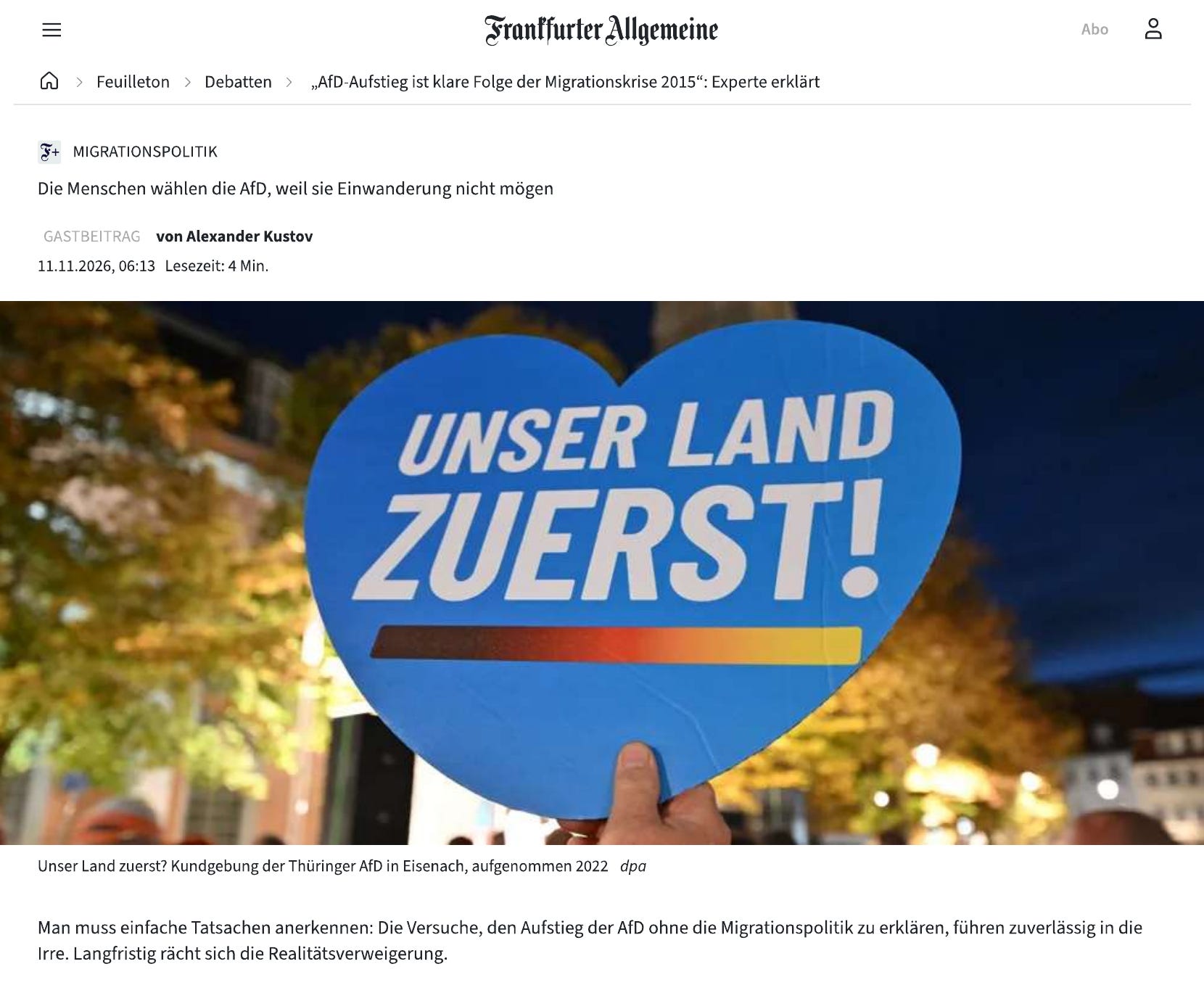
I have a new piece in the Frankfurter Allgemeine Zeitung. In September, the far-right Alternative for Germany (AfD) came first in the eastern state of Saxony-Anhalt. Within hours, people on X were arguing about what AfD voters were really upset about. Soon they were passing around a chart from the Financial Times. It showed that in last year’s federal election, the AfD did better where fewer residents were foreign nationals. Some people took that as proof that the voters’ real grievances lay elsewhere. The economist Tony Annett even put the AfD’s gains down to rising inequality, austerity and the loss of cheap Russian energy. A few days later, he shared the chart and wrote, “It’s not actually immigration. It’s blaming immigrants for being left behind. It’s neoliberalism.”
The historian Anton Jäger later made a subtler version of the same move in a New York Times essay. He acknowledged that Europeans care about immigration, but argued that the deeper reason for their preoccupation is that “Europe doesn’t know what it is.” Well, that looks like a lot of smart words to end up treating a policy disagreement as a question of European identity.
So why do we see more anti-immigration votes in places with few immigrants? This common correlation mostly shows who lives where. Educated professionals tend to favor immigration wherever they live, and they cluster in big cities, where the high-skilled jobs are. In surveys that follow the same people over time, people don’t become more pro-immigration after moving to a big city.
The chart also plots levels, while what people actually react to is change. The share of foreign nationals doubled in Saxony-Anhalt between 2015 and 2025, from roughly 4 to 8 percent. Over the same period it went from about 12 to 16 percent in North Rhine-Westphalia. Those are both four-point increases, but a doubling feels much bigger. In his classic U.S. piece, the political scientist Daniel Hopkins found that sudden local increases were most likely to provoke opposition when the national debate already cast immigration as a threat. And people can look at the big cities and decide they don’t want their town to become that.
Voters also care about what they think immigration is doing to Germany as a whole. In ARD’s exit poll, 96 percent of AfD voters in Saxony-Anhalt said they liked that the party wanted to limit the arrival of foreigners and refugees more than other parties did. I think we can take them at their word. I hate being “Captain Obvious,” but people vote for anti-immigration parties because they don’t like immigration. Or at least because they don’t like how their governments are managing it.
So, yes, you can live in Wyoming, hundreds of miles from the southern border, and still care how Washington handles it. Nobody asks or should ask whether you’ve lived through a flood before taking your views on climate change seriously.
What frustrates me is that some of the people who usually worry about misinformation saw a correlation that fit their argument and took it as a reason to discount what voters say. Disagreeing about whether certain immigration policies are good or worth it is normal politics. But if you want voters to give a different policy a chance, you have to reckon with why they’re unhappy with the way immigration is managed now.
Agree. But what don’t they like about it? Economic costs exceed benefits? (If so aren’t there fixes?) Immigrants don’t assimilate? Immigrants DO assimulate? (Either way isn’t this a selection criterion problem?) And if a voter doesn’t like immigration how does that make them anti Ukraine?
I think I was one of those pushing for a different interpretation, along with Tibo Rutar https://lmguirola.substack.com/p/would-a-stricter-immigration-policy .
To repeat a bit: I don't think there is any conclusive evidence that, with less immigration, AfD would have got significantly less votes:
- Stated preferences about immigration are endogenous to attitudes towards parties (and politics more generally). In other words, it is not clear to me what comes first, discontent against mainstream parties/support for AfD, or attitudes towards immigration.
- In the counterfactual with less immigration, there might be other problems which may boost that discontent and boost support for the radical right. This has general equilibrium effects.
I wouldn't go as far as to say there is no evidence about the effect of immigration. What I am saying is that the evidence that we have so far can also be interpreted along other lines.