



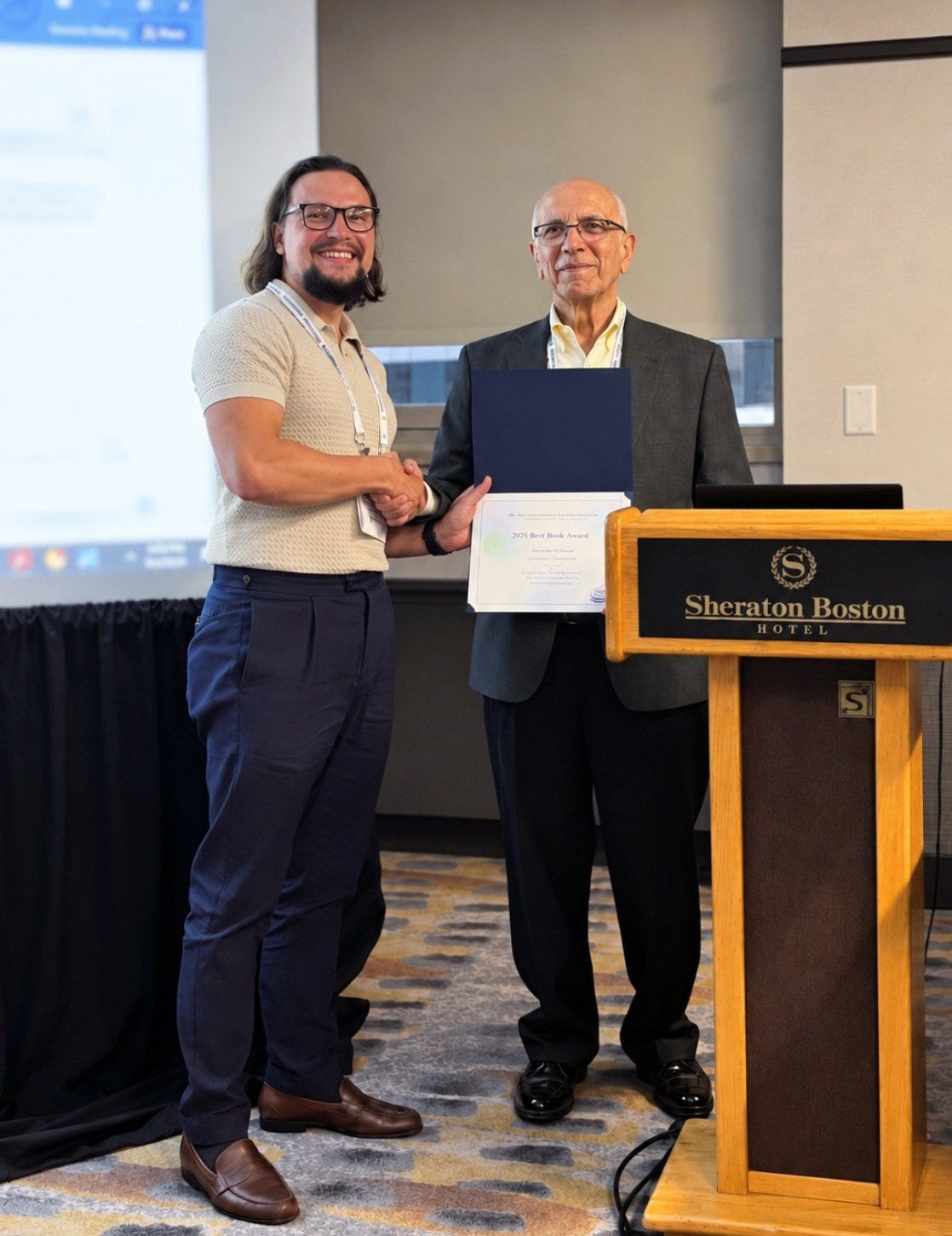
Some good news first. In Our Interest received the Best Migration Book Award from APSA at this year’s meeting in Boston. I am also grateful to colleagues who checked up on me and who appreciated my stances and provocations even when we disagreed. If you liked the book, please rate or review it on Amazon and spread the word.
This issue is going out a few days early because this is the last call for two chances to meet in person in Washington, DC next week. On Thursday, October 1, the Making Immigration Better workshop I am organizing at Notre Dame’s DC office (1400 16th St NW) opens with a public reception and a keynote from Johannes Haushofer, the Cornell development economist who founded Malengo. Drinks start at 5pm and the talk around 5:40, and the registration form stays open until we hit capacity. Then on Saturday, October 3, from 10am to noon, I am hosting the first ever Popular by Design reader meetup over coffee in Dupont Circle. RSVP on Luma and I will send the exact location to everyone who does. If you are in the Bay Area instead, I will be at the Progress Conference in Berkeley the following week (October 8-11), making the case that the progress movement and the abundance crowd should go all in on top talent migration.
Later in October I am taking the show to the UK for a mini-tour to present my new book project, Immigration for Realists (I’ll be writing more on that soon). For those of you in London and nearby, here is where to find me:
Tuesday, October 20, 5:30pm. London Migration Research Group seminar at LSE.
Friday, October 23. Oxford, the Department of Politics and International Relations research colloquium, at lunchtime.
Monday, October 26, 2pm. King’s College London, PPE research group seminar.
Wednesday, October 28, 4pm. Brighton, the 13th SCMR-JEMS Annual International Migration Conference at The Old Courthouse. The conference is open to all, and you can register on Eventbrite.
Friday, October 30. Newcastle University.
In case you missed it: Earlier this month I published How Australia Already Made Immigration Popular and How to Keep It That Way. I wrote the original version for an Australian magazine last month, but reposted it here with Germany in mind, where the AfD had just taken almost 44 percent of the vote in Saxony-Anhalt. Then, after the far right finished first in yet another German state while the mainstream right lost ground, I published Why Governments Don’t Have to Restrict Immigration to Save Democracy, an updated version of a research note I wrote in 2024 for the European University Institute’s Migration Dilemmas project, in response to Zsolt Kapelner.
Book mini review of the month:
👍 Monica Prasad’s Problem-Solving Sociology: A Guide for Students (Oxford University Press) is written for sociologists who set out to solve problems but end up only describing them (or mostly complaining about capitalism and racism, to be frank). Prasad names three traps of doing such research as usual, chief among them describing the victims and critiquing other people’s solutions without offering anything yourself. Her fix is to study the people and institutions who could actually change the situation (who may even be the “villains”), and, in her words, to “spend less time cataloguing [victim] suffering and more time cataloguing what causes it.”
I thought it was a great book and would recommend it to any researcher, including folks outside of sociology and academia. The author is obviously left of center, but given that her main target audience is extremely left-wing sociologists, it is remarkable how much she pushes back on the field’s habits, from defending objectivity to insisting that refusing to solve problems is a normative position too. Her observation that a literature focused on describing the oppressed ends up feeding the very stereotypes it wants to fight describes the humanitarian focus of a lot of immigration research pretty well too. My only reservation is the audience fit: to non-sociologists it can read a bit too jargony. But I also really appreciate the humility of an author who admits she has not solved any social problems herself but is pushing this agenda anyway.
Here are the September links (linking does not imply endorsement):
The UnPopulist reads the AfD’s shocking near-44% in Saxony-Anhalt as the firewall breaking. Since many folks asked me about the result, I wrote a brief FAQ with links. The short version: people vote for anti-immigration parties because they don’t like immigration, particularly when it is a nationally salient issue like it is now. Voters care about what they think immigration is doing to Germany as a whole, and it is now almost impossible to deport anyone from Germany, even when their asylum application is denied or they commit a crime, as I wrote in July.
Noahpinion argues that liberalism needs a new philosophy of immigration, built on three principles: migration is not a human right, immigration law must be enforced, and immigration should benefit the citizens of the receiving country. My readers will find most of this familiar, but I am glad to see it stated this plainly from the liberal side.
Anton Jäger in the New York Times says there’s a reason Europe is so obsessed with immigration, and the reason is that “Europe doesn’t know what it is.” That’s a lot of smart words to conclude Europeans’ worries about immigration are actually about something else. Folks should consider the possibility that Europeans vote for anti-immigration parties because they genuinely don’t like migration or how their governments manage it.
The same week, a chart made the rounds showing that far-right support is highest where there are the fewest foreigners. I think folks should stop using the negative correlation between foreigner shares and far-right support as proof that immigration isn’t at fault. Cosmopolitans self-select into areas with more foreigners, and people care about migration as a national issue beyond their own locality.
Tibor Rutar replies to me directly: yes, voters who fear migrants are sociotropic, and? He grants the finding and argues it cuts the other way. Voters with no skin in the game have no incentive to check what they absorb from the media, so sociotropic concern makes them easier to mislead. Fair enough, but my response is that the same “rational ignorance argument also applies to pro-immigration cosmopolitans, even if they are on average better educated.”
Fergus Peace at Migration Weekly asks how Australia should manage partner visas. For my US readers who think literally everything we do is dysfunctional: Australia charges an A$11,000 upfront fee for a marriage green card, then grants only a set number a year, and that quasi-cap is why couples now wait two years or more. Doesn’t seem ideal. His fix is a demand-driven program, with the honest caveat that governments can always tighten eligibility through other means.
Paul Goldsmith-Pinkham ran economics papers through AI detectors to ask whether writing is AI-generated. Almost nothing was flagged in 2022, while roughly half of recent arXiv economics papers and about a quarter of NBER papers now have at least one section that reads as AI-written, and the newer detector version finds even more.
Incidentally, can someone start a prediction market on when academics will give up on shaming their colleagues for using AI to improve research? Possible resolution: a major academic publisher adopts an explicit policy that 100% AI-written papers are OK. My bet is within the next three years.
Andrea R. Flores at Securing America’s Promise argues that Democrats are still scared of immigration. Hakeem Jeffries’s governing agenda leaves it out entirely, while Republicans have outspent Democrats on immigration ads by more than three to one, $53 million across 88 races against $17 million across 20. Gary Winslett makes the general version of the point in Don’t Try to Bait-and-Switch Voters: you cannot campaign on one thing and govern on another, and you certainly cannot talk voters out of the issue they have already ranked first. Similarly to what Hanno Hilbig here argued about populist breakthroughs, mainstream parties need to deliver visible improvements in immigration policy.
Lyman Stone rounds up some recent and quite surprising fertility news. South Korea’s marriages and births are both rising after its 2022 to 2025 expansion of marriage subsidies, and Japan is creeping into positive birth territory for the first time in roughly a decade, against his own prediction.
As before, if you want me to write more about one of these or other related topics, let me know! And see you in DC, Berkeley, or London.