



As always, if you would like to support the mission of Popular by Design and keep these essays free for everyone, you can do so with a premium subscription.
Earlier this month, The Chronicle of Higher Education asked Carolyn Rouse, the Princeton anthropologist who currently leads the American Anthropological Association: Is her field hopelessly politicized? A new report commissioned by the chancellors of Vanderbilt University and Washington University in St. Louis had just named anthropology the most extreme case among the six fields it reviewed.
I highly recommend the full interview to everyone, academics and non-academics alike, because her answers read like a very enlightening demonstration of the charge. In the course of one interview, she dismissed the report as chatbot output, waved away a survey of her own subfield because she does not “believe in opinion research,” and compared the teaching of binary sex to astrology.1 In short, the president of a major social science discipline’s flagship association does not seem to know what the public or even her own field believes, and does not treat the disagreement over many contested ideas as legitimate.
In public, there was very little defense of the interview’s substance, mostly just the reflexive assumption that any such critique must be a bad-faith right-wing attack. But this reflex reaches well beyond anthropology. And watching other social scientists—including my friends—defend those assumptions all week, in my own replies, forced me to finally reckon with an argument about the need for more viewpoint diversity I had previously mostly dodged. So, what I’ll try to convince you here is that, even if we grant that the reality famously has a liberal bias, we still need more researchers of conservative persuasion to understand that reality.2
Some academics deny the discrimination is happening; others now defend it
The discussion started innocently enough. Two weeks ago, the left-wing Atlantic writer Tyler Austin Harper asked whether anyone seriously believes that a geographer critical of immigration could get hired by an elite American university. In response, a history professor called him a “right wing grifter” who had supposedly left his tenure-track job because none of his colleagues would eat lunch with him, then deleted everything when challenged.3
Then, many academic and left-wing commentators moved on to denying that any discrimination against people with conservative viewpoints is happening at all.4 And, to be frank, I’m increasingly losing patience with folks on this straight-up highbrow misinformation. We have years of anecdotal accounts, we have deans on record running demographic checks on hiring pools, and we have surveys of academics in which many openly said they would discriminate against conservative colleagues in decisions ranging from paper reviews to hiring. I have also seen it myself. I have sat in rooms where search committees explicitly discussed candidates’ ideology. And I have experienced the softer end of the same machinery many times, even though I am not even a conservative.5
The most clarifying development of the week, though, was the number of academics who skipped the denial and moved straight to defense. One widely shared post put it plainly: “academics with noxious right wing views are less likely to get hired,” and “personally I just don’t give a shit.” I appreciate someone finally saying it out loud. But that is not what I signed up for when I entered grad school, and it is not a good way to run a society where people disagree.
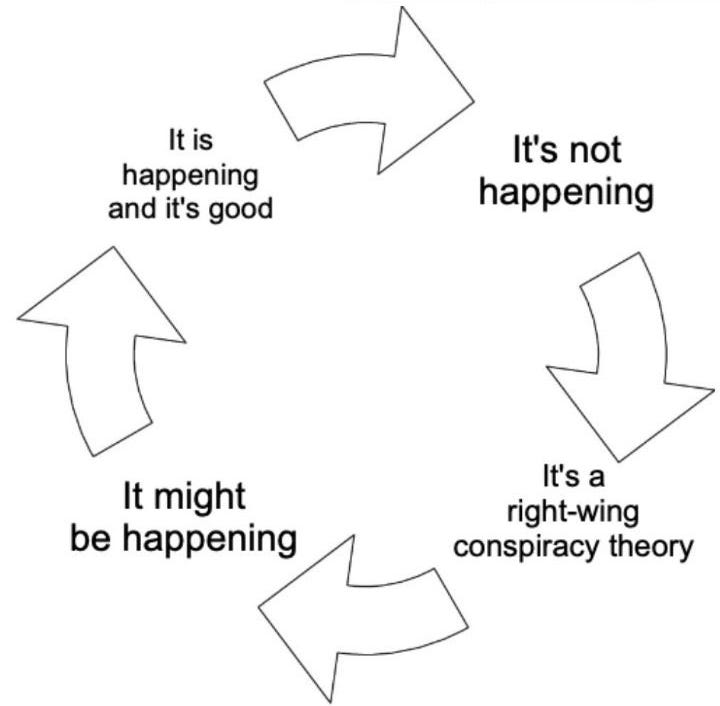
Why it would be OK to hire a climate skeptic in the environmental science department
Whenever someone makes the case of viewpoint diversity, the same gotcha arrives on schedule: so would you allow a climate skeptic in your environmental science department? A migration skeptic in your geography department? If you think about it for a moment, this is a much less reasonable gotcha than many assume. But I haven’t seen a single person in this debate is proposing to hire vaccine or evolution deniers in immunology or biology departments.
The assumption underneath the gotcha is that the missing conservative positions are “village idiot” views, ancient prejudices that could never generate scholarship. But if you cannot state the serious conservative case on immigration restrictions or biological sex, that is exactly an argument for hiring colleagues who can. A field that only ever meets the village idiot version of the other side never engages the serious one, and it arrives unprepared for a policy world made of exactly this messiness and disagreement. Indeed, much of the pushback was also a constant masterclass in scoring zero on Bryan Caplan’s ideological Turing test of trying to understand conservatives and their beliefs, not to mention liberals like me with some idiosyncratic opinions about the world.
The gotcha also works only by conflating two different people, the one who denies verifiable facts and the one who weighs trade-offs differently. Unlike flat denial of the facts, climate and migration skepticism is often a disagreement about the trade-offs involved. Most academics rarely, if ever, hear the argument for why migration should be restricted or carbon emissions allowed from inside their own field. That is why we slide into groupthink, give bad policy advice, and get distrusted in the first place.6
Some sociologists were still skeptical and asked which viewpoints are actually missing in their discipline. My serious answer, which clearly resonated with many, though sadly not with the sociologists themselves, was that the discipline would benefit from practicing colleagues who hold and can voice some genuine small-c conservative beliefs as their starting assumptions. I gave a few examples, not meant to be comprehensive: that inequality is not necessarily a problem, that migration restrictions can be justified, or that social order is important. The inequality claim, for some reason, proved particularly controversial and occasionally came back through the replies as the noted conservative Notre Dame professor believes inequality is good actually, which I thought made the case for viewpoint diversity in sociology better than I ever could myself. Since then, the list has kept growing, with nominations arriving from colleagues across the political spectrum.
Are any of those views completely absent in sociology or other social sciences? Probably not. But they are certainly vastly underrepresented and discouraged. To give you a sense of how bad things really are in sociology, the London School of Economics once produced a promotional film asking, in its own title, “Are There Any Right-Wing Sociologists?” The faculty’s answers were fascinating. One guessed that such colleagues probably exist somewhere, “perhaps there in criminology, perhaps they’re doing migration studies” (narrator: they are not). Another offered the reassurance that the department is “certainly not homogeneous,” containing as it does “hugely varied debates within a broadly left concern.”
I wish I could say this is not representative of the field, but much of the senior reaction was honestly almost as disappointing as the Rouse interview, with prominent sociologists seriously denying any underrepresentation of conservative views and wondering how anyone complaining about anti-conservative discrimination could be tenured in the first place. By that standard, of course, no social group with any employed members has ever faced discrimination anywhere. And this is exactly why we need divergent viewpoints in sociology: double standards like this get called out right away only when somebody in the room does not share them.
The taxpayer is always at the door, whether you like it or not
There is an important reason this all cannot just stay an internal academic conversation. Just days ago, The Wall Street Journal ran a widely shared essay by Pamela Paul asking whether it is time to “liquidate” the study of sociology. Back in March, I wrote that the standard explanations for academia’s drift—left-wing bias and self-censorship—always seemed incomplete to me. A bigger factor was simply forgetting about the taxpayer who funds us, directly at public universities and through grants, student aid, and tax exemptions everywhere else. As Tyler Austin Harper rightly pointed out, many of the angry responses to his viewpoint diversity points tacitly assume the public owes the Ivory Tower trust and money while deserving no say in what goes on there. Academic freedom is a privilege and it makes no sense for us to incessantly antagonize the mainstream society whose good graces we depend on.
Indeed, nobody is obligated or wants to hire vaccine deniers or worse, however such views happen to poll. But taxpayers’ views are not negligible, especially on normative issues that are not ultimately resolvable by science. Where a field’s disputes are mostly about values and priorities, and the college is financed by taxpayers who overwhelmingly believe those views are fake, full autonomy is simply not a stable arrangement, and academics should not be surprised when the public’s trust and funds disappear. As Matt Lutz strikingly notes in his recent piece, “defunding police and the abolition of biological sex categories are two of the least possible ideas in politics today, and both are products of the critical humanities. If those ideas had stayed in unread academic journals, we might not be in this mess.”
So, which viewpoint diversity are we talking about here?
Let me be clear. I can see how the demographic diversification of the social sciences over the last decades has been, on the whole, genuinely good for knowledge. In my own field, scholars from migrant-sending countries and minority communities pushed migration studies beyond its old preoccupation with movement into rich Western countries to South-South migration, and migrants’ own decision-making. Diverse researchers asked questions the old professoriate had not thought to ask, which arguably improved our knowledge overall.
For some reason, folks in academia find it harder to accept the same logic when the underrepresented dimension is ideological, and yet the imbalance there is far larger. When Musa al-Gharbi ran the numbers for Heterodox Academy, comparing each group’s share of the professoriate to its share of the population, the lack of ideological diversity in social research fields came out “vastly more pronounced” than underrepresentation by gender, race, or sexuality. Now, you may object, as some academics did, that conservative arguments are hardly marginalized in our society, so why should universities of all places carry them? Fair enough, but I have yet to meet anyone who thinks conservatives must be represented in academia in proportion to the population. That standard is somehow reserved for demographic diversity, where we routinely demand proportionality despite everything we know about self-selection.
What people like me are actually asking for is much more modest: for these and other non-leftist views to be openly and institutionally represented at all without any drama. There are entire social science departments without, as far as anyone can tell, a single open conservative in them. And, again, we are often not even talking about actual conservatives, just people with a few heterodox beliefs who remain well to the left of the median voter. Jesse Smith put it best: the faculty ratio is valuable as a proxy, and misleading if mistaken for the problem itself. What academia needs is people who pursue neglected questions and challenge orthodoxies, and, given the current makeup of the academy, such people now tend to be conservatives.
If you think about it, demographic diversity was often defended with the same proxy logic, the category standing in for the perspectives that usually come with it. Viewpoint diversity simply goes after those perspectives directly. A room that is diverse on every demographic dimension but homogeneous in its viewpoints—a common situation these days—has plenty of the diversity that matters least for truth-seeking and none of the kind that matters most.
So, it would be helpful to be more precise about what is currently missing. My sense is that the most absent sensibility is small-c social conservatism, the disposition Bo Winegard describes as grounded in human flawedness, with its preference for order and its distrust of utopian schemes. The sociologist Jesse Smith, whose essays over the past year have shaped my thinking here more than anyone else’s, calls these orienting assumptions, paradigms that shape which questions a scholar asks without predetermining any answers. Nobody, of course, needs colleagues who reject findings whenever the findings are inconvenient; that failure is already amply represented in academia. But the dispositional core—skepticism of rapid change and attention to what maintains social order—is a set of research priors, and these priors generate fruitful research questions. Here’s my attempt to group those succinctly:
A degree of social hierarchy may be natural and even useful, and inequality is not necessarily a problem.
Social order is hard to build and worth maintaining, and social change often happens too quickly.
Many well-meaning government attempts to improve society will fail.
Crime deserves punishment, and communities need protection from the small share of people who commit most of it.
Religion is, on net, a social good. Traditional families and higher fertility deserve active support.
The questions immigration research keeps not asking
Let me come back to my own field of migration for a moment. My sense is that these are the questions that the actual majority of voters keep asking or, at least, wondering about: What are the long-term consequences of permanent low-skilled migration, including for migrants’ descendants? What are the local consequences of rapid demographic change? Under what conditions do temporary worker programs actually protect native workers? Which design features make legitimate law enforcement effective?
Every one of these can be studied with the field’s standard tools, and none of them is untouched: there are careful fiscal accounting exercises, evaluations of guest worker programs, scattered work on local reactions to demographic change. What the field lacks is an organized research program built around these questions at anything like the scale their public salience warrants, or anyone synthesizing the scattered answers for the conditional middle that keeps asking.
Relative to how much these questions move voters, my sense is that the attention they get is rather thin. And I do not think it is a coincidence that each of these questions is a small-c conservative one. Instead, a huge chunk of immigration research focuses on various aspects of aiding humanitarian immigration, which matters too, but is not where most voters’ concerns are.7
George Borjas has long been the most prominent economist pressing the restrictionist case, but we need more. One famous dissenter is not enough, and without serious competition, neither his arguments nor ours get properly stress-tested. Jerusalem Demsas, herself arguing from the left, says a lack of conservative pushback simply makes liberals lazy. I wholeheartedly agree. When there are more colleagues around you who have genuinely different priors about the world, the harder it is to publish weak work that flatters any shared assumptions. And a field that will not answer the questions voters keep asking should also not be surprised when voters take those questions to populist entrepreneurs who at least pretend to care.
What would actually help
So what to do? I want to be honest about my uncertainty, because the serious people in this debate genuinely disagree. Demsas bites the bullet and says that universities should adopt straightforward DEI for conservative academics and accept that some hires will be less qualified, alongside expanding elite universities and reforming admissions so the conservative pipeline exists at all. Jesse Smith counters that nobody should be hiring Republicans for the sake of balance, the way DEI hires for their self-professed identity. Rather, the point is to get scholars who ask the questions the field neglects and push back on its orthodoxies. He has since made this case at full academic length and sharpened it further just this week. Meanwhile, other folks, including those who are conservative themselves, strongly disagree. Ashley Rubin, for instance, doubts increasing viewpoint diversity can be a good reform or even metric on the merits and would rather fix incentives for scholarly excellence directly.
I personally don’t have a strong stance on whether affirmative action for conservatives is a good idea. I do know that creating a metric of how many conservatives work in each department would not be healthy. Metrics, as always, would get gamed, and we would have self-declared heterodoxy and quota-filling long before we got the thing we want. And here I agree with Jesse Smith that we should want more people who push back on unreasonable priors before those priors harden into findings or are discovered by regular voters through the Fox News medium.
I also want to be plain about the political moment, because a version of this argument is currently being most actively made by an administration coercing universities with funding threats and ideological conditions. Nothing in this essay supports that campaign. Government-imposed viewpoint quotas would just replace one political test with another. That is precisely why I think universities should fix this themselves, precisely so that nobody else gets to (and they are currently failing to do so).
There are gentler levers, and they do not require anyone to count party registrations. Adversarial collaborations, including with the think tanks where many conservative researchers actually work. Post-publication review with teeth. Letting outsiders, funders included, put questions on the field’s agenda. It is also worth noticing what a decade of that movement has actually won. The concrete victories are rare and procedural, like the wave of institutional neutrality statements. So anyone promising a quick fix here is overselling you something.
In the end, intellectual disagreement should be welcomed and encouraged in academia. Right now, in too many spaces, it is quietly punished instead. I spent years assuming the people who said so were exaggerating for political reasons, but the past week showed me close colleagues saying the punishment is deserved. Whether the answer involves anything as blunt as reverse discrimination for conservatives, I honestly still do not know. But at the very least, making the environment friendlier to these ideas institutionally by design—because we need them to understand the world better—would be a good start.
Huge thanks to Mike Riggs, Jannik Reigl, and Codex for their helpful suggestions on the draft.
To be more specific, she dismissed the Vanderbilt report in three words, "They used AI," and compared it to student chatbot papers even after the interviewer pointed out that its authors had openly described using AI the ordinary way, to survey large bodies of text. She waved away a 2022 survey in which 42 percent of forensic anthropologists agreed that sex is binary, on the grounds that "I don't believe in opinion research" and that many respondents are coroners who "haven't had advanced schooling." She said that forcing biological anthropologists to teach that sex is binary would be "the equivalent of turning an astronomy department into an astrology department," and suggested that people who insist otherwise "maybe... want to kill babies" that fall outside those categories. The report's sole anthropologist, Joseph Henrich, she said she had never heard of. The Chronicle‘s own follow-up asked whether she had made things worse.
That is, at least when it comes to understanding the social world. As Hollis Robbins rightly notes, there is more to universities than the possible ideological disagreements among social scientists.
Of course, every well-educated person knows that, when someone criticizes the academic monoculture, whatever their actual politics, they must absolutely and unabashedly be “right-wing.” It should not matter if this person sits to the left of 90 percent of voters on most issues, as long as they are even slightly less left than the rightful accuser.
Also see a more detailed recollection of these events and viewpoint diversity debates.
For those who are curious, my ideological views lean slightly liberal but are quite idiosyncratic (which is not uncommon for an immigrant socialized across multiple political environments). But I'm also on the record supporting right-coded things like US nationalism, freedom of speech, and… air-conditioning.
John Robert Thomason at The Argument recently ran a piece on the left's own climate denial problem, meaning the refusal to run honest cost-benefit analysis on green policies. Once you separate facts from trade-offs, the "denial" label cuts in directions that should make everyone uncomfortable. I have previously made the same argument regarding immigration.
To be fair, when researchers went looking for ideological bias in published immigration research, they did not find much. The best-known recent claim that our ideology skews our results has been seriously challenged by reanalysis, and careful reviews of the broader evidence come up mostly empty. Unfortunately, though, a bias test can only compare the studies researchers ran, while saying nothing about the studies nobody ever started.
This was very good. I in particular like your enumeration of 'small-c conservative propositions' that are undersaturated *specifically ideologically* in the academic discourse and social space relative to their utility. I think a great way of sidestepping broader affective dismissal (which of course itself is revealing, but may not help generate uptake) is to brush aside the issue of What Are We Calling Conservatism and instead click down a level of resolution to spotlight classes of claims that really aren't bearing many loads relative to what they ought.
I confess I just skimmed this, but I recall that there have been quite a few papers on the impact of immigration on wages. The results has been mixed, with studies from the 90s suggesting mild downward pressure and more recent ones little discernible effect. (Correct me if I’m wrong; this is from pure memory.) This was a major question at one time, and if there is no longer any large scale research program related to this, I suspect it is because it no longer seems like promising ground for a strong finding.
More broadly, I suspect academics will always tilt left for organic reasons. I believe intellectually is correlated with receptivity to new ideas (right or wrong), and so is political liberalism.