



Most research on immigration opinion, including most of what I’ve written, is about who gets in. Today’s guest essay by Taylor Trummel, a political scientist at Denison University, asks what Americans want once immigrants are here. She finds more partisan consensus than you might expect. Democrats and Republicans alike are more supportive of services for immigrants when they see the rules for access as fair. Just as with admissions, people support or oppose these services conditionally, which leaves a lot of room for better policy design. Enjoy!
In December 2022, Newsweek ran a headline asking why the country was spending millions housing illegal migrants while Americans went homeless. In another article, one New York City resident stated, “The city is going to put forth a ton of money for these people who aren’t even citizens, but they forgot about the people who live in public housing right here.”
As asylum seekers arrived in New York City, residents already facing a housing crisis watched migrants receive hotel rooms and shelter beds. At the same time, some migrants slept on the streets when there was nowhere left to go. Either way, many New Yorkers were angry.
Within a year, an overwhelming majority of New Yorkers agreed that the influx of migrants was a serious problem. Most disapproved of how the city was handling the situation, including many of those typically considered to be more likely to hold “pro-immigrant” views, such as liberals, Democrats, and racial and ethnic minorities.
The standard explanations were familiar. Perhaps exposure to more migrants made New Yorkers more xenophobic. Perhaps migrants’ use of city services strained public budgets and provoked an economic threat. Perhaps the perception of disorder triggered a desire for tempered control. I contend that these explanations are not sufficient.
Following the situation in New York City, I set out to understand whether people were genuinely upset by which groups received help, how much it cost, the perceived chaos, or whether it might be something else entirely.
From news headlines to quotes from residents, many weren’t expressing sentiments that were inherently anti-immigrant, although a binary knee-jerk reaction would have sorted them that way. Rather, as I saw it, many were describing issues of fairness. Although New York City’s experience inspired the question, my recent research looks at immigrant integration policy across the United States, drawing on nationally representative surveys of American adults.
The first consensus
Frequent readers of this outlet probably know the first immigration consensus well—attracting skilled workers is popular. A decade ago, Jens Hainmueller and Daniel J. Hopkins showed that beneath partisan divisions, Americans broadly agree about which immigrants they prefer to be admitted: educated workers in high-status jobs who arrive legally and speak English. In In Our Interest, Alexander Kustov builds on this to argue that immigration becomes popular when it is selective and demonstrably beneficial to the receiving country. Countless studies around the world have shown similar results. A meta-analysis of immigrant profile conjoints underscores that cultural, economic, humanitarian, and legal factors all influence judgements. Most opposition is not primarily driven by xenophobia. Rather, citizens will support more open policies when they are confident that immigration is orderly and managed in the national interest.
This consensus is about the front door: who gets in and how many. However, admission is only one part of the migration cycle. Once immigrants arrive in the United States, states and cities often decide what goods and services they can access. Federal law excludes unauthorized immigrants from most public benefits and the One Big Beautiful Bill Act of 2025 went further by cutting federal food aid for refugees, asylees, and other humanitarian immigrants who had previously qualified.
States are left to decide whether to fill these gaps. From food aid and housing to English classes, subnational governments determine a number of integration-related conditions for immigrants. From 2008 to 2023, at least 4,486 immigration-related bills were enacted in state legislatures. Yet, we know far less about what the public wants from integration policy than about what it wants from admissions. My research suggests there is a second consensus here too.
Fairness has more than one meaning
Most research explains immigration attitudes through cultural threat or economic threat. Both have been found to be influential to attitudes, but they miss a perspective that guides our everyday judgments: fairness. Fairness has long been central to research on redistribution. Charlotte Cavaillé, for example, argues that nearly everyone endorses fairness norms, but people disagree about whether the status quo lives up to them. The problem with fairness is that it means different things to different people. A Republican might believe integration policy is unfair because it is too generous, while a Democrat might believe it is unfair because it is not generous enough. A survey question that simply asks whether a policy is fair would indicate both individuals in agreement, despite their diametrically opposed reasons.
To overcome this challenge, I draw on Jennifer Hochschild’s work on distributive justice and measure four dimensions of fairness without ever using the word “fair.” These four dimensions of judging a fair outcome are standards of equality, need, investment, and ascription. Equality holds that everyone deserves to be treated the same. Need holds that some people deserve more in order to achieve equality. Investment holds that people deserve rewards in proportion to what they contribute. Finally, ascription holds that some groups naturally deserve more than others. The same person can apply all four principles to different issues within minutes.1
What Americans want from integration policy
In April 2025, I fielded a conjoint survey experiment with a nationally representative sample of just over 3,000 Americans. Respondents were asked to imagine that their state was adopting a new law to help immigrants integrate. Each policy combined randomly assigned features: eligibility rules, social services, and the region of origin of the immigrants who would primarily benefit. The eligibility rules included legal status, proof of employment, and a background check while the potential benefits included food aid, a $200 monthly debit, a month of shelter or hotel vouchers, and low-cost English or U.S. history lessons. Respondents saw five policies each, rated how fair they were on the four dimensions, and selected whether they wanted their state to adopt them.
Two findings stand out: offering services and including eligibility criteria both increased support. Compared with offering no benefits, food aid, cash, shelter, and hotel vouchers all made respondents more likely to support policy adoption. These are costly, publicly funded programs, which is hard to square with a purely economic threat story. To the second finding, eligibility rules increased support even more. Requiring a background check raised support by roughly 11 percentage points, the largest effect of any feature. Requiring legal status and proof of employment also increased the probability of support.
Policies with rules for access, as well as those providing social services, were viewed as fairer on all four dimensions of fairness, albeit with varying magnitudes. This variation also highlights that perceptions of a fair outcome do not always equate to policy support, and vice versa. Someone may agree that offering shelter to asylum seekers is fair under the need dimension but still oppose the policy out of self-interest.2
Who benefited mattered surprisingly little. Policies primarily benefiting Middle Eastern or African immigrants were not detectably less popular than those benefiting Europeans. If anything, policies benefiting Latin American immigrants were slightly more popular. Origin shaped two fairness judgments. Respondents were less likely to agree that policies benefiting Middle Eastern immigrants would help people who contribute or fit in. That said, region of origin was the least important feature in effecting support overall.
Partisans differed in the experiment, but less than one might expect. Democrats supported every type of benefit and service tested. For Republicans, most services had no detectable effect either way. An exception was cash aid, which lowered Republican support. Both groups favored rules for access, suggesting a promising area for bipartisan reform.
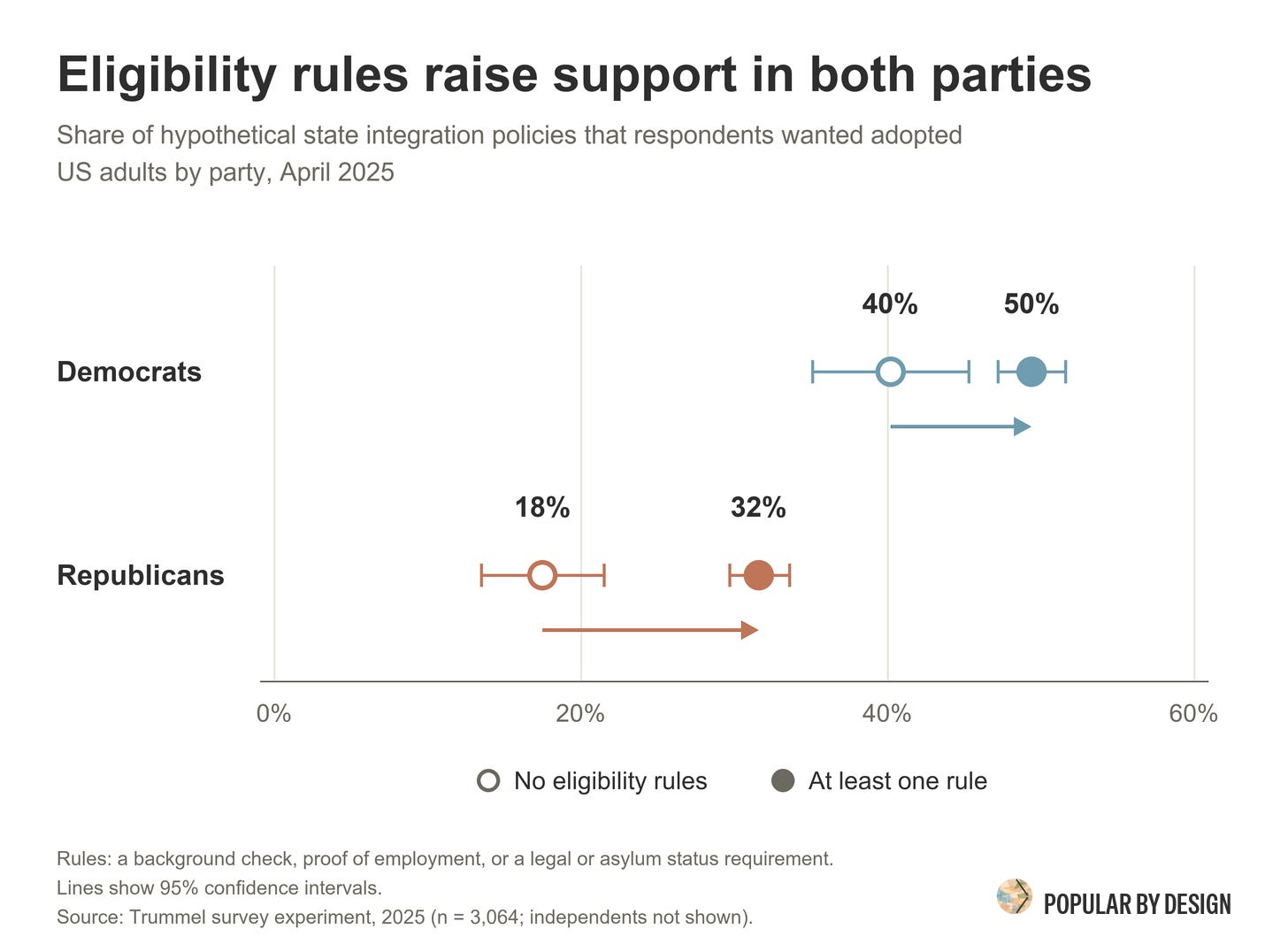
Overall, respondents supported 38 percent of the policies they evaluated, though support split along party lines. Democrats backed one half of all policy iterations, while Republicans backed just a third. When a policy included no eligibility criteria, Republicans expressed support for just 18 percent of them, but adding even one rule for access raised their support to 32 percent. Democrats responded to these rules as well, with support rising from 40 to 50 percent. This provides further evidence suggesting that eligibility criteria are not a concession to one side but a design choice that partisans on both sides reward.
Does support survive a price tag?
A reasonable objection is that support is cheap when nobody mentions what it will cost. Public opinion research has long shown that support declines once people learn what costs a policy entails. So, in a second study with Clayton Nall, fielded in April and May 2026 with just over 2,500 respondents, we asked people to choose between pairs of state policies that would provide four months of food aid to newly arrived immigrants. Each policy listed its eligibility rules, the national origin of the main beneficiaries, and an explicit annual cost to the average taxpayer ranging from $1 to $600.
As expected, cost matters a great deal. Even $12 a year lowered support and $600 lowered it dramatically. However, two eligibility rules substantially offset that opposition. Respondents were willing to accept considerably higher costs for policies requiring a criminal background check or legal status. Notably, not every restriction earns this premium. Requiring proof of employment had no detectable effect.
National origin mattered more in this study than the region of origin in the first, possibly because these cultural cues were made more precise. Policies primarily benefiting Mexican immigrants drew more support than those benefiting Ukrainians, while Chinese, Nigerian, and Somali beneficiaries drew less. Yet even the largest penalty, for Somali immigrants, was smaller than the positive boost from a background check. In other words, rules for access moved support more than the identity of who received help. Additionally, background checks again moved Republicans and Democrats at a similar magnitude.
Why rules feel fair
Why would background checks and legal status earn a premium when employment rules do not? The answer appears to be terms of equality. Background checks and legal status resemble the civic, rule-based terms that already determine access to many public programs. Among respondents who endorsed equality as a general principle, those who believed that background checks help “ensure that immigrants are treated just like everyone else” sustained higher support at moderate price points than those who did not. Among respondents who named legal status as the policy feature most important to helping everyone equally, requiring legal status produced the largest positive effect on policy support of any feature.
In other words, the public generally does not object to helping immigrants. It objects to benefits that appear to operate outside the rules everyone else follows. This echoes what Morris Levy and Matthew Wright call civic fairness: the idea that Americans judge immigration through values like equal treatment and respect for the rule of law. Abstract fairness beliefs on their own, meaning those that mirrored the immigration specific statements but without reference to a particular policy domain, did little in influencing the outcomes. This suggests interpretation of a fair outcome is highly context dependent. What appears influential is whether a specific policy feature matched the fairness principle a person applied to it.
The other consensus
Taken together, the evidence points to a second immigration consensus. Americans across party lines are more likely to support state services that help immigrants integrate, and will even pay for them, when access comes with clear, universal civic rules. Where Kustov’s consensus is about selection at the border, this one is about the conditions for inclusion after arrival. Together, they cover a broader picture of immigration policy. Sergi Pardos-Prado’s recent work finds that “watermelon” regimes, strict on entry but inclusive afterwards, outperform both free movement and stricter policies in enhancing satisfaction with democracy and political trust among migrants. My findings suggest that the American public may be most supportive of a version of that same combination.
The best cases against from across the spectrum
There are reasonable objections from both ideological directions. From the left, the most important may be that these rules exclude the people who often need help most. Unauthorized immigrants are among the most economically vulnerable residents in the United States. A legal status requirement shuts them out of programs designed to facilitate integration. Background checks also carry real costs. They require state capacity, slow down claims, and may do little actual screening, since recent arrivals have short domestic records and records from countries of origin are often inaccessible to subnational officials. Because of this, their value may be largely symbolic.
Public programs depend on public trust and such symbols can help build it. A background check that rarely disqualifies anyone can still reassure skeptics that a program operates on terms they recognize as fair – i.e. the perception that “undeserving criminals” who might abuse the system would be prevented access. It is also possible that these national results do not generalize to all states. For example, Californians may not have the same overwhelmingly positive effects on a legal status requirement. Only large, state-specific samples can authoritatively illustrate the route local policymakers should take and how this may affect the immigrants within those states.
Overall, integration programs that lack broad legitimacy are politically fragile. A policy that reaches fewer people but keeps its funding and public support may ultimately serve more people over time than a more universal program that collapses under backlash. New York City’s experience is instructive here, as the city stopped giving prepaid debit cards to migrants in November 2024 after sustained criticism.
From the right, a few possible objections spring to mind: 1) integration help is unnecessary and 2) any spending on newcomers rewards unauthorized entry or acts as a pull factor. To the first point, one could nod to the fact that immigrants in the United States participate in the labor force at higher rates than natives. European countries that spend heavily on integration see worse outcomes, largely because their labor markets make it structurally harder for newcomers to work. It could be argued that access to welfare slows assimilation by reducing the pressure to find work.
Yet Republicans in my studies did not reject services outright. Most services had no detectable effect on their support, and requiring proof of employment had small but statistically significant positive effects. This could help address concern about economic integration. Furthermore, increasing interaction between immigrants and the state could even improve integration.
Research from Mette Foged, Linea Hasager, and Giovanni Peri suggests that in Denmark increased language training and initial placement in strong labor markets improved refugees’ long-run labor market outcomes and that cutting initial welfare payments did not improve them. Comparing the United States and Canada, Irene Bloemraad shows that greater state support for settlement is associated with increases in citizenship acquisition and political participation.3 If the goal is for immigrants to integrate, offering state assistance can help.
To the second objection, Madeline Zavodny’s research from the 1990s found that new immigrants in the United States tend to settle where earlier immigrants from their home countries already live, not by how generous a state’s welfare benefits are. More recently, Jeremy Ferwerda, Moritz Marbach, and Dominik Hangartner found the same pattern in Switzerland. Namely, municipalities that raise benefits do not attract more immigrants. Despite its prominence, the pull-factor argument is not universally supported.4
A non-ideological objection may be about the effectiveness of such integration benefits and services. Public support helps a program survive, but it is not evidence that the program improves outcomes for immigrants or their communities. Some of the aforementioned studies address this. Another case from Norway finds that integration programs can help with language skills and employment, but hinder educational advancement and feelings of belonging. Public support and program effectiveness both matter for integration policy, and both deserve research attention as more states adopt these programs.
What this means for policymakers and advocates
For state and local officials, the lesson is fairly simple. Pair integration benefits with clear eligibility rules that mirror the terms many citizens already face. Citizens already show documents to start a job or enroll in Medicaid, as well as pass background checks to live in public housing or work with children. Rules like these signal that a program operates on familiar terms.
Lead with less controversial services like food aid and English classes rather than cash. These services are less likely to provoke backlash. Finally, because eligibility criteria moved opinion far more than origin did, do not assume that the identity of the beneficiaries will make or break support. With the federal government narrowing who qualifies for aid, more states will face these choices. How they design access may matter as much as what they offer.
For immigration advocates, the findings from my work may be uncomfortable. Eligibility rules are often treated as barriers to be dismantled. Public concern is often read as hostility toward immigrants. Yet the access rules that moved opinion most are ones many citizens already face, and they ultimately made the public more willing to fund services, not less.
Advocates who want to support immigrants already here may build more durable coalitions by engaging the public on the issue of fairness rather than dismissing its concerns as inherently anti-immigrant. This does not require abandoning those that eligibility rules leave out. It may mean pairing broadly popular public state programs with community, faith-based, or charitable efforts that can reach people those programs do not.5
The terms of inclusion
All that said, my evidence stems from survey experiments, and stated preferences do not translate directly to votes for a host of reasons. For one, both studies were fielded during a period of heightened attention to immigration enforcement, when attitudes appear to have moved in a thermostatic direction. In June 2025, Gallup found that a record 79% of Americans called immigration a good thing for the country. Some of the warmth toward Latin American and Mexican beneficiaries in my studies may reflect that moment. These more positive attitudes and the salience of immigration may not hold in the next administration.
Second, further research could explore whether these national results generalize within specific states, especially those that have sizable immigrant populations and active backlash. The case of Minnesota and the “Quality Learing [sic] Center” comes to mind.
Still, the core result held across two years, two samples, and two designs. Americans are not simply pro- or anti-immigrant. Just as the first consensus showed that the public cares about who comes, the second shows that the public cares about how newcomers are included and whether those rules for access align with their conception of fairness. Durable integration policy depends less on what it offers than on the terms under which it is offered.
If you’re curious about that, empirically, these measured dimensions are also distinct from political ideology and from six other related measurements such as humanitarianism, Moral Foundations Theory, and the Migrant Deservingness Scale
We see a similar dynamic play out among NIMBYs, who support affordable housing in principle until it is proposed down the street.
Relatedly, a causal design from Jens Hainmueller, Dominik Hangartner, and Giuseppe Pietrantuono shows that naturalization improves political integration in Switzerland.
The strongest evidence on the other side comes from Denmark, where the researchers found that cutting benefits for non-EU immigrants by about half reduced net immigration by about 5,000 people a year. So the evidence is mixed, and benefits may matter more for whether people come to a country than for where they settle once there.
For example, many food banks serve anyone in need without asking about immigration status, often through networks of local churches and community organizations.

Useful study. Interesting literature review. That may not sound like high praise, but it is.
You raise a hypothesis in the introduction, however, that neither your study nor the other ones you cited seems to address: namely that contact with immigrants or direct negative effects from immigrants might reduce support for immigration.
Anecdotes are dangerous, of course, but I lived through the rise in anti-immigrant sentiment in Brooklyn. (Not upscale Brooklyn, to be clear.) My next door neighbor became vociferously anti-immigrant when hotel rates spiked after the refugee influx, forcing him to put up his in-laws in his house when they came to visit. My wife's support for immigration dropped when she began to see little kids selling candy on the subway for the first time, well, ever. The owner of the neighborhood hardware store complained that contractors were hiring utterly unqualified Venezuelans; conversely, my morning coffee conversations at the corner bodega often featured mini-rants about how much cash was being showered upon them making them unwilling to work.
FWIW, everyone involved here is of Puerto Rican or Dominican descent, and the neighborhood swung hard to Trump in 2024. (Not that he got a majority, of course, just a 20-point swing.) In a sense, then, the negative reaction controlled for race and partially-controlled for culture, although I'm still just giving one anecdote.
The question, then, is how much results from surveys reflect how people react when they are directly confronted with effects they find unpleasant or distasteful. The strong effect you find on annual cost per taxpayer, even when presented abstractly and hypothetically, makes me worry that the survey effect won't actually travel to real public opinion.
If my worries give you an idea for future surveys or experiments, then I will consider this comment a success!
P.S. Your findings on linked fate among Latinos don't fit my priors, but I'll admit that I don't have great controls since my personal experience is mostly in New York and Florida. Assuming the result is correct, however, I worry about unobserved variable bias. For example, public education might be more likely to be biased towards immigrants or celebrate ethnic identities. Your finding on Latino-linkage v. immigrants in general leans against that particular hypothesis, but you might want to consider other more direct ways of addressing unobserved variables.
Great article!
It would be very helpful to understand how educational migration can play a more prominent role in integration.
Similarly, it would be helpful to understand if a generous student lending program can fund services to balance costs. Then that allows a higher bar over time. We understand you don't speak Dutch/German/Japanese when you arrive but we will lend you money for classes and we expect you to have language acquisition by year 5. Similarly, we understand you don't have a degree now but we lend you money for certain programs and after 10 years we expect you are over a high bar.
I genuinely don't know how punitive left wing people view lending or how generous right wing people view it. Or similarly how punitive a left wing person views refusing a visa renewal if someone can't learn the language in 5 years.
Sorry that I am asking such a specific question! But I genuinely really appreciate the scholarship and want to learn more.