



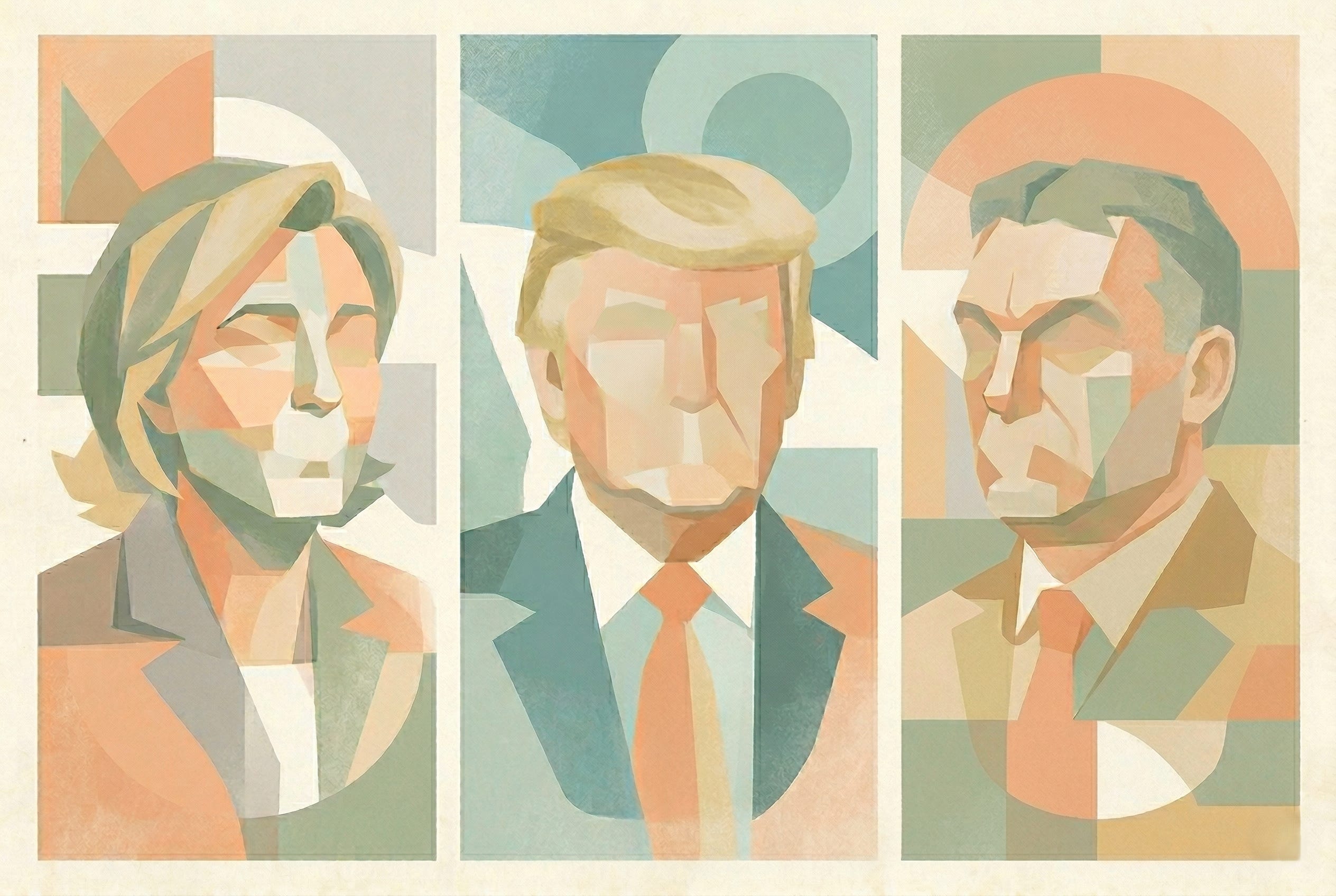
Why does yelling about “corrupt elites” seem to work in politics? From Donald Trump to Viktor Orbán to Marine Le Pen, politicians who rail against the establishment and claim to speak for “the real people” keep winning elections. The populist playbook, us versus them, the pure people against the rotten elite, appears to be one of the most effective strategies in modern democratic politics. But what if it isn’t?
I’ve spent the better part of a decade studying populist rhetoric with my co-author Yaoyao Dai, now at the University of Pittsburgh. We just published our third and latest paper on the topic, and I thought this was a good moment to reflect on what our research program has found. The short version: populism’s power is real, but much more limited than most people assume. And the reasons why it works are not what you’d expect.
What we mean by populism
Before getting into the findings, a quick definition. Political scientists generally follow Cas Mudde’s influential framework, which defines populism not as a full political program but as a simple worldview (or what Mudde calls a “thin ideology”). This worldview is based on three pillars: people-centrism (politics should reflect the will of “the people”), anti-pluralism (there is one authentic popular will, not many competing interests), and moralized anti-elitism (elites are not merely wrong but evil). This is what scholars call “thin” populism because it doesn’t tell you much about actual policy. A left-wing populist like Hugo Chávez and a right-wing populist like Trump share the same rhetorical structure, the people versus the elite, but disagree on virtually everything else.
This distinction between populism and its “host ideology” (the actual policy positions a politician holds) turns out to be crucial. Because when you peel them apart, something surprising emerges.1
When politicians gamble on populism
Our first paper, “When Do Politicians Use Populist Rhetoric?“ published in Political Communication in 2022, asked a deceptively simple question: if populist rhetoric is so effective, why don’t all politicians use it all the time?
To answer this, we built the most comprehensive corpus of U.S. presidential campaign speeches at the time: 4,314 speeches from 1952 to 2016. We used a novel text analysis method combining active learning and word embeddings to measure how much populist rhetoric each candidate employed across the campaign trail. I (Alex) should say, thanks to the prowess of Yaoyao, we did all that fancy text analysis stuff before it was cool and before LLMs were even around.
The pattern was striking. Candidates who were trailing in the polls consistently used more populist rhetoric, regardless of whether they were Republicans or Democrats, incumbents or challengers. Populism, we argued, is a gamble: a high-risk, high-variance strategy that trailing candidates adopt because conventional campaigning isn’t working. If you’re already behind, why not shake things up?
Think of it like a football team that’s losing in the fourth quarter. You start throwing long passes not because they have a higher expected value, but because safe plays guarantee you lose. Barry Goldwater, George McGovern, and Donald Trump (in 2016, when most polls had him behind) all fit this pattern. They reached for populist rhetoric when they had little to lose.2
The (in)effectiveness of populist rhetoric
But does the gamble actually pay off? Our second paper, published in Political Science Research and Methods in 2024, tested this directly with a survey experiment.
We presented U.S. respondents with pairs of realistic campaign messages from hypothetical primary candidates. The messages varied on two dimensions: populist features (people-centric language, anti-elite attacks, anti-pluralist framing) and substantive policy positions (on immigration and other issues). This design let us isolate the effect of populist rhetoric from the underlying policy content, something that is nearly impossible to do when observing real elections, where populism and policy positions come bundled together.
The result was unambiguous: none of the populist features had an independent effect on candidate choice. Not people-centrism, not anti-elitism, not anti-pluralism. Not individually, and not in combination. What did matter, enormously, were policy positions that aligned with voters’ own preferences. Voters chose candidates based on what they promised to do, not on how dramatically they framed the conflict between the people and the elite.3
This finding is consistent with other experimental work. When researchers across multiple countries carefully separate populist style from policy substance, the style itself contributes very little to voter decisions.
So: if populist rhetoric doesn’t actually persuade voters, why does it seem to work? Why do populist candidates keep winning?
What populism is actually good for
This puzzle motivated our newest paper, our first ever registered report (where scholars publicly specify their hypotheses before running their experiment), now published at Research & Politics. We hypothesized that populism’s real contribution might not be persuasion but mobilization: getting people who already agree with you to actually show up and vote.
Previous studies, including our own, used what’s called a “forced choice” conjoint experimental design: respondents had to pick one candidate or the other. But in real elections, people can also stay home. To capture this, we ran a large-scale, preregistered survey experiment that added an “abstain” option, a seemingly small change that turns out to matter a lot.
What did we find? First, the basic persuasion result replicated: policy positions still dwarfed populist rhetoric in driving vote choice. Having a policy-congruent candidate increased the probability of voting by a massive 27 percentage points. Populist rhetoric, by contrast, had no meaningful persuasion effect.
But here is the twist: populist rhetoric did have a small but statistically significant mobilization effect. Having at least one populist candidate in a race was associated with a ~1.5 percentage point decrease in abstention. The effect was concentrated among voters who already held populist attitudes and encountered a candidate whose policy positions they liked. In other words, populist rhetoric didn’t convert skeptics; it energized true believers to get off the couch.
Meanwhile, non-populist voters did not appear to punish their preferred candidates for using populist rhetoric. This asymmetry is key: populism is a low-cost mobilization tool. It fires up your base without alienating persuadable voters.
Are hypothetical but cleanly identified ~1.5 percentage points a lot? In most elections, no. But in a close race (and modern elections in the U.S. and Europe are often decided by razor-thin margins) even a small mobilization advantage can be decisive. This may help explain the apparent paradox: populist rhetoric doesn’t change many minds, but it doesn’t need to. It just needs to get a few more supporters to the polls.
The media amplification question
There’s one more possibility worth considering: the role of the media. Populist rhetoric is, almost by design, dramatic and newsworthy. When a candidate calls the entire political establishment corrupt and claims to be the voice of the forgotten people, that generates coverage, and coverage generates name recognition, which generates votes.
The most vivid illustration is Trump’s 2016 campaign, which received an estimated $2 billion in free media during the primaries alone, far more than any rival. Much of that coverage was driven by his populist style: the outrageous claims, the attacks on the “swamp,” the rallies designed for television. Journalists couldn’t look away. And there is some evidence in the growing media populism literature that this pattern generalizes beyond Trump, with populist candidates across countries receiving disproportionate media attention relative to their actual electoral standing. That’s what our Notre Dame colleague Marc Jacob recently found too, but in the case of negative politics and political insults more generally—it captures and generates attention.
If populist rhetoric’s main benefit is generating outsized media attention, which then translates into awareness and mobilization, then the mechanism isn’t really about what populism says to voters. It’s about what populism says to journalists. This is consistent with our finding that populism mobilizes rather than persuades. But the media-amplification hypothesis still needs direct testing, and ambitious PhD students should certainly take this on (unless we or our Claude Code get to it first).
What does this all mean?
So what is populism actually good for? Based on our and other recent research, we’d summarize it this way:
Populist rhetoric is a gamble, adopted primarily by candidates who are already losing. It’s a variance-increasing strategy, not a winning formula.
It doesn’t persuade. Voters care about policy positions, not populist framing. The “host ideology,” what you actually promise to do, matters far more than how dramatically you frame the people-versus-elite conflict.
It may slightly mobilize, particularly among voters who already hold populist attitudes and agree with the candidate on substance. This is a modest but potentially consequential effect in close elections.
Media amplification may be a key mechanism, turning populist drama into disproportionate coverage. But we need more direct evidence.
The biggest takeaway, both for those who fear populism and those who are tempted by it, is that substance matters more than style. Politicians who deliver tangible results, or credibly promise to, will outperform those who simply shout louder about corrupt elites. This is consistent with what I (Alex) argue in my recent book, In Our Interest, in the context of immigration: policies that are demonstrably beneficial do more to win and maintain public support than any amount of rhetorical framing.
Populism is not nothing. But it’s not the all-powerful electoral weapon it’s often made out to be. Don’t confuse volume for effectiveness. The people who keep winning elections on populist platforms are winning mostly because of what they promise and do, not because of how they talk about it.
There can be other definitions of populism or even slopulism. For a broader overview, Yaoyao and I recently wrote a short primer on populism research for Good Authority.
For an accessible overview of our second paper, see our Loop piece.
Populist rhetoric is used because political leaders want to lead, voters want influence, and there is often a prevailing sentiment that powerful interests and rich people have skewed society too much in their favor. People are motivated when inspired, and that enthusiasm might give a small mobilizing boost at the polls, as you suggest. But this rhetoric does not have to be of the ‘thin’ populist variety to be used or effective. Populism can be pro-pluralist, and it can be more pro-working class than anti-elitist. Candidates that use ‘broad’ populist rhetoric just don’t end up being called populists in office because they embrace pluralism. Curious what your analysis is with a broader definition of populism and populist rhetoric.
Interesting results! I am working on a paper for SPPC, and I found across "Trump" elections, and effect between 1.6 and 2.1 percentage points on turnout to vote share. With your independent results, seems like I might not be imagining things! I'll be sure to cite your paper!