



As many of you know, I’ve been thinking a lot about immigration and crime, and about the overconfident claims on the issue that often come from even the best academic experts. So I’m excited to share this guest post from Sascha Riaz, a political scientist at Singapore Management University, whose recent paper published in a mainstream journal explains why most studies of immigration and local crime rates come up empty. I hope his basic point resonates with pro-immigration advocates and makes the debate more productive.
Immigration has been one of the most salient political issues in Western democracies over the past decade. In 2015 and 2016, when asked about the most important issues facing the EU, Europeans named immigration more often than any other issue. In 2025, majorities in all seven Western European countries surveyed by YouGov said immigration over the past decade had been too high, including 81% of Germans, 80% of Spaniards, and 71% of Britons. In all seven, the most common view was that immigration had been mostly bad for their country.
While voters connect many different concerns to immigration, crime often stands out as the most salient issue. In the 2014 European Social Survey, it ranked ahead of concerns about the economy and culture in 18 of 21 countries.1 Nearly a decade later, in the International Social Survey Programme, it did so in 19 of 20 Western countries:
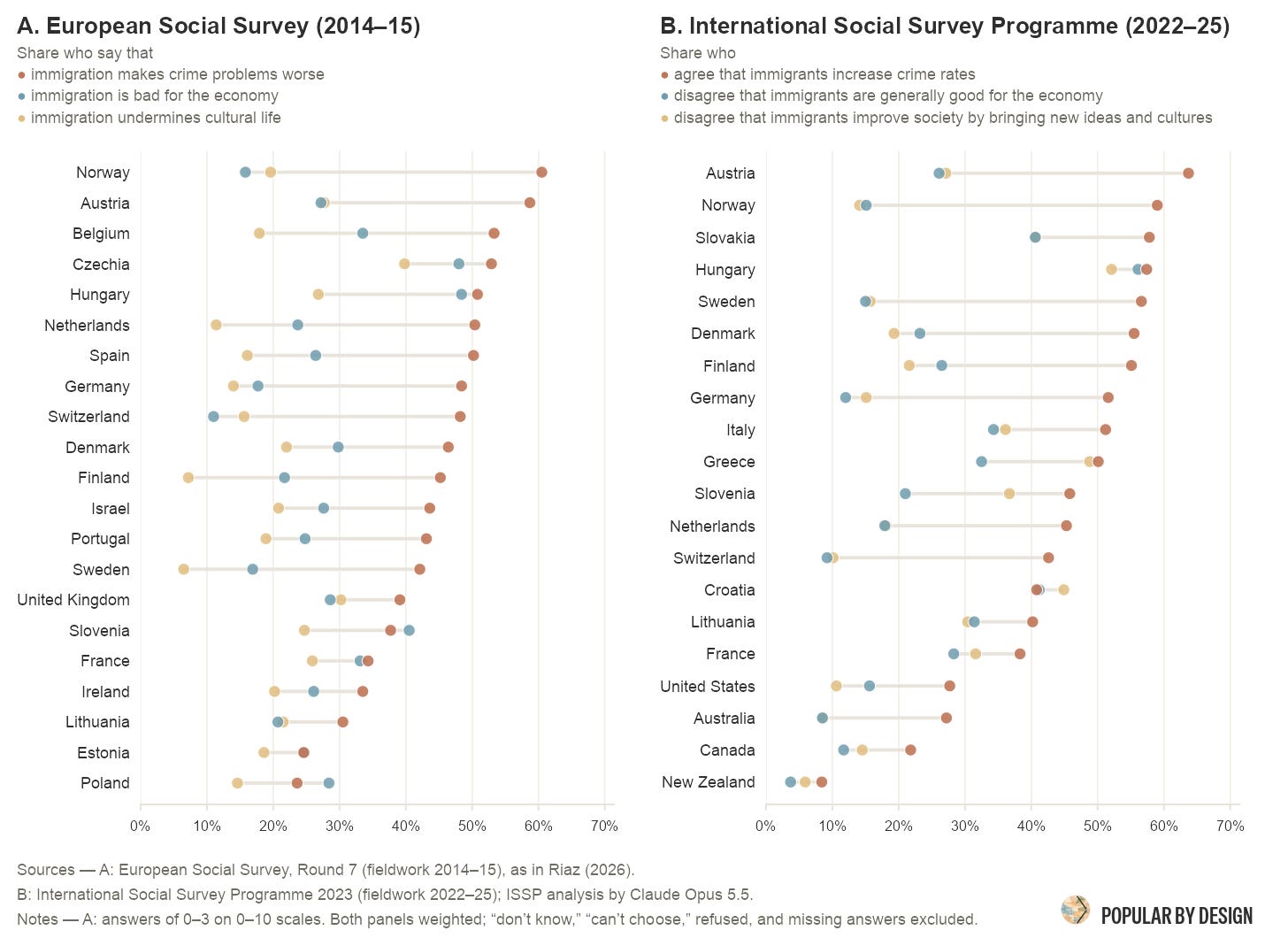
Politicians both respond to and amplify concerns about immigrant crime. Donald Trump opened his 2016 presidential campaign by saying that Mexico was sending people who were “bringing crime,” adding, “They’re rapists.” In 2017, the Dutch far-right leader Geert Wilders spoke of “Moroccan scum” making the streets unsafe. Such rhetoric is not limited to the populist right. Denmark’s Social Democratic prime minister, Mette Frederiksen, told parliament in 2019 that “far too many of those who have come here commit crimes. Or their sons do.” Gérald Darmanin, then interior minister in Emmanuel Macron’s centrist government, said in 2022 that “it is clear that we have a problem with crime by foreigners.” In 2025, Germany’s center-right chancellor, Friedrich Merz, spoke of a “problem in the cityscape” that deportations would address and, when asked what he meant, told reporters to “ask your daughters.”
Given the salience of the immigration–crime link, a large literature in political science and economics has sought to quantitatively examine whether immigration increases crime. Typically, researchers in this literature estimate sophisticated aggregate-level statistical models, such as difference-in-differences or instrumental-variables designs: changes in crime rates across geographic units (such as counties, municipalities, or police districts) are regressed on changes in the local share of immigrants. The best of these studies seek to move beyond correlations by exploiting exogenous shocks to the local immigrant population, such as those created by refugee crises or abrupt policy changes. Most of these studies find no statistically significant relationship between immigration and crime.2
News coverage often links these null results, explicitly or implicitly, to differences in offending between immigrants and natives, even though the studies mostly address a different question (as I explain below). In the last week of Germany’s 2025 election campaign, for example, the Frankfurter Rundschau covered a county-level analysis by the ifo Institute under the headline “Migration and crime: study refutes link.” Citing the ifo researchers, a Tagesschau report explained the null result by suggesting that migrants are about as prone to crime as the Germans living in the areas they move to.
In a recent paper published in the British Journal of Political Science, “Null by Design: Statistical Dilution in Immigration-Crime Research,” I take a closer look at what exactly can be learned from the literature about the link between immigration and crime. I argue that even where these studies are well executed, and all identifying assumptions hold, they say little about the question that drives much of the public debate: whether immigrants, in particular recent arrivals, commit crimes at higher or lower rates than natives. Instead, they primarily test whether immigration changes how often natives offend. This may be an interesting research question in its own right, but it is neither what most of the public debate is about nor the main motivation of most of these studies.3
In a nutshell, the dilution problem endemic to this literature is that immigrant inflows are usually too small relative to the population to move overall local crime rates much, even when immigrants and natives offend at very different rates. This means these studies systematically lack statistical power, making a null result likely and rendering many of them “null by design.” Before explaining this problem in more detail, I want to make clear that this post does not take an empirical stance on whether immigrants offend more or less often than natives. As I explain below, the immigrant–native crime gap is not a single, fixed quantity but highly context-dependent. My point here concerns what we can learn from much of the published research on immigration and crime, and to what extent it speaks to the public debate.
Two ways immigration can move crime rates
When we think about the link between immigration and crime, it is important to first be clear about which mechanism, or quantity of interest, we have in mind. Depending on the mechanism, an aggregate-level regression of the type described above may or may not be a suitable research design. Broadly speaking, an immigration inflow can shift local crime rates in two ways:
Immigrant–native crime differences. Immigrants may offend at different rates than natives. If per-capita crime rates differ between newcomers and the pre-inflow population, an inflow mechanically changes the crime rate. These differences can be driven by:
Composition. Immigrants may differ from natives in age, gender, socioeconomic background, and other characteristics that drive crime propensity.
Incentives. Immigrants may face differential incentives to engage in crime (poor job prospects, legal status, risk of deportation, etc.).
Natives’ response. Even if there is no crime gap between immigrants and natives, immigration inflows may change overall crime rates to the extent that they shift how often natives offend. This may occur, for example, if policing practices change in response to immigration, because of increased job competition, or through other indirect mechanisms.4
The key issue is that aggregate-level regressions can be well powered to detect changes in natives’ behavior (2), whereas the public debate, and the motivation of most of these studies, is primarily about composition and incentives, i.e., immigrant–native gaps in per-capita crime rates (1).
Aggregate-level regressions are null by design
The arithmetic behind the dilution problem is simple. An area’s crime rate is the number of crimes divided by the number of residents.5 Because natives make up most residents, the overall crime rate mainly reflects their behavior and changes in it. Differences in crime rates between immigrants and natives, on the other hand, show up in the overall crime rate only in proportion to the size of the inflow.6 Relative to the total population, even the largest inflows are typically small, so they barely shift crime rates.
To see this, consider an inflow that adds 0.03% to a county’s population (roughly the yearly refugee inflow into the United States, as a share of its population, before the 2017 refugee ban discussed below). If immigrants offend at the native rate, the per-capita crime rate stays the same. If they offend at twice the native rate (a substantial gap), it rises by only about 0.03%, and even at five times the native rate, by only about 0.1%. Even an inflow more than 30 times larger, like Germany’s in 2015 and 2016, would raise crime rates by only about 1% if newcomers offended at twice the native rate. Of course, this holds in both directions: to the extent that immigrants commit fewer crimes than natives, this is likewise washed out in aggregate data. Even for large immigrant–native crime gaps, the signal in the data is systematically diluted due to small year-on-year changes in population shares.
In the paper, I show how the minimum detectable gap (the smallest immigrant–native crime differential a given study can detect) depends on a study’s parameters, such as the size of the shock, year-to-year idiosyncratic fluctuations in crime rates, and the number of geographic units in the data.7 The smaller the shock, the larger the gap must be to show up. Because even the largest immigration shocks are typically small relative to the total population, only very large immigrant–native crime gaps can be detected in most settings.8
A nice example of this point is a study published in the American Political Science Review by Daniel Masterson and Vasil Yasenov, “Does Halting Refugee Resettlement Reduce Crime? Evidence from the US Refugee Ban.” The authors study the January 2017 Trump executive order that temporarily halted refugee resettlement to the United States and find no discernible effect on property or violent crime in counties that had received many refugees before the ban. The study is, as far as I can see, carefully executed and empirically sound. Crucially, however, the drop in annual refugee arrivals amounted to less than 0.1% of residents in nearly all counties. In the paper, I show that the study’s confidence intervals are therefore compatible with refugees offending at up to about 22 times the native rate for property crime and 28 times for violent crime. I agree with the authors that the policy had little discernible effect on local crime. However, the study tells us little about the crime propensity of refugees, even though, as Masterson and Yasenov note, fears that refugees increase crime were part of the push to cut their admission.
There is no general “effect” of immigration on crime
The dilution problem does not mean that previous studies of immigration and crime are wrong, but it does limit what we can learn from them. To the extent that a null result rules out only very extreme crime gaps between immigrants and natives (e.g., refugees offending at 30 times the native rate or more), only voters with such extreme prior beliefs should update them after hearing about the results of such a study. Hopefully, few voters hold such beliefs.
There is also a deeper, and arguably more important, problem: a causal design may not be necessary in the first place. To the extent that we care about the immigrant–native crime gap, the quantity of interest is descriptive, not causal, and can often be measured directly, since official statistics in many countries already break down offenders by nationality. Needless to say, official crime statistics can be biased.9 But many of the same biases affect aggregate-level regressions, which typically rely on police-recorded crime as well. Sometimes a good mere description is all policymakers need.
In a recent talk at PolMeth Europe, Macartan Humphreys makes a related point about survey experiments. When the quantity of interest is descriptive, an experiment may be unnecessary, and it “may add error without adding value.” His example is deliberately extreme: to estimate the average age in a population, we could randomly split respondents into two groups, ask one group for their year of birth and the other for the current year, and take the difference between the two averages. This gives us an unbiased estimator. But it is also absurd: simply asking people their age is obviously the better approach. Using aggregate-level regressions to speak to the debate about the immigrant–native crime gap is a less obvious version of the same idea: researchers estimate a descriptive quantity indirectly through a causal design, which is unnecessarily complicated and adds a lot of statistical noise.
Finally, the immigrant–native crime gap is not a fixed quantity. It is highly context-specific and depends on the composition of the immigrant population relative to the native population in that context (most obviously in terms of age and gender, but also in terms of other characteristics that predict crime).10 Who migrates, in turn, depends on policy choices. Accordingly, the immigrant–native crime gap varies widely across countries with different selection and integration policies: immigrants are underrepresented in prisons in the United Kingdom, the United States, and Australia, but overrepresented in much of continental Europe.11 As with most other things of consequence, there is thus no single causal effect of immigration on crime for a study to identify, only the effects of particular inflows of particular people under particular conditions. In this respect, the link between immigration and crime is an extreme case of a familiar limitation of causal research: the difficulty of generalizing from one setting to another. Asking whether immigration increases crime in general is not a fruitful research question, because there is no general answer to be discovered.
In my view, a more promising avenue for future research is what to do about crime: how to bring crime down in general and, in some cases, among immigrant groups in particular. Here, causal studies of specific policies that shift the incentives migrants face, such as giving migrants legal status or letting asylum seekers work, can inform policymaking. Future research should be steered in this direction.
In Estonia, the shares who say immigration makes crime problems worse and who say it is bad for the economy are tied at 24.6% (24.61% and 24.63% before rounding), so Estonia does not count among the 18.
Lauren Gilbert has recently reviewed this literature for the United States and Europe.
In the paper, I review 15 aggregate-level studies published between 2012 and 2025. By my classification, 10 find no statistically significant overall effect, two find that immigration increased crime, one finds a negative relationship, and two find mixed results. Every study but one, which discusses no mechanism, discusses how immigrants and natives differ in offending; only about half discuss changes in natives' offending, often as a side issue.
In discussing aggregate-level studies, I follow the paper for simplicity and use "natives" for everyone who lived in an area before the inflow, including earlier immigrants.
For total crime counts rather than rates, the question would be close to tautological: unless immigrants commit no crimes at all, increasing the population will increase the number of crimes.
In the paper, I assume that natives’ behavior does not change, which gives the design its best chance to detect crime differentials. If natives do respond to immigration, the gap becomes even harder to detect.
The derivation assumes no omitted variables, reverse causality, or other sources of bias. To the extent that the models are misspecified, such regressions may of course produce spurious significant results, regardless of the dilution problem I outline.
Very large shocks can make the design well powered, although it remains an indirect and noisy way to measure the gap. See here for an example in the Greek setting of 2015–16.
In a 2015 survey of teenagers in Lower Saxony, violent incidents against German victims were reported to the police 13% of the time when the offender was German but 27% when the offender had an immigrant background. In the United States, undocumented immigrants report crimes against them less often, as do Hispanic victims when immigration enforcement raises fears of deportation. Police and courts may also treat foreigners more harshly. As Alex Nowrasteh notes, homicide is less underreported than other crimes. Texas records that break down homicide convictions by immigration status show lower rates for both illegal and legal immigrants than for native-born Americans. He also points out that police clearance rates are no different in states with many illegal immigrants than in those with hardly any, which suggests that illegal immigrants do not often escape arrest.
Crime is concentrated among young men across societies, and immigrants are often younger and more often male than natives. In Germany, 69% of first-time asylum applicants in 2015 were male. In Sweden, as Tibor Rutar notes, adjusting for age, sex, income, education, and municipality type lowers the foreign-born risk of being suspected of a crime between 2015 and 2018 from 2.5 to 1.8 times the native rate.
In England and Wales, non-citizens made up 12.1% of prisoners in June 2025, close to their estimated 13.5% share of adults, but a smaller share once age is taken into account. In the United States, immigrant men are about 60% less likely to be incarcerated than US-born men. In Australia, where most permanent visas go to skilled migrants and their families, 32% of residents in 2025 had been born overseas, but only 14% of adult prisoners. In Germany, excluding residence-law violations and suspects living abroad, there were 52 foreign suspects per 1,000 foreign residents in 2023, against 19 per 1,000 Germans.

While rates get a lot of press, it sidesteps an important issue. If an immigrant wasn't here, they couldn't commit a crime here. It's not like someone here would step in and commit that crime in the would-be immigrant's place.
I think this is an excellent article, but kind of misses Why people were looking at overall crime rates, the point of those studies or at least the point I took away from them is that hysterical claims that the actual streets of Europe have certainly become way more unsafe, and you can’t leave your home without fearing being attacked are wrong, whether that is because immigrants are not more likely to commit crime or because there’s just a few of them is an interesting question, but not the point of those studies which were mostly to show that the overall situation has not changed significantly in response to present immigration. Of course, I could be wrong about this, but this is generally my experience when I hear people bring up those studies.