



Update: Just as this went out, the Supreme Court upheld birthright citizenship in a 6-3 decision (Trump v. Barbara), striking down President Trump's executive order and holding that the Fourteenth Amendment guarantees citizenship to nearly everyone born on U.S. soil.
This month I went to Ireland for the first time, splitting two weeks between Dublin and Belfast for two conveniently timed political science conferences. To make sure this was not just a nice European vacation (before the heat wave), I took one of those “both-sides” walking tours of “the Troubles” through the peace walls and murals, standing in the streets where neighbors were killing each other just a few decades ago. I teach courses on war and conflict, and “the Troubles” is one thing I always assign to my students, to show how even a relatively wealthy democratic society slid into something close to civil war. It is all a useful corrective to the comfortable assumption that prosperity completely inoculates a country against political violence.
Now for the good news: not every academic conference is a slog. I had two on this trip, the Conference of Europeanists (CES) in Dublin and the inaugural European Political Science Society (EPSS) meeting in Belfast, and both were genuinely good. I came away impressed by the venues and the quality of the presentations, which is not something I say lightly. Regular readers know how little I enjoyed my last big conference, the 2026 ISA convention in Columbus, where I sat through (mostly absent) tenured scholars reading bad arguments off their slides. These were a different experience entirely, and a reminder that both human and AI slop is avoidable when people care. Another benefit of a good conference: in Dublin I caught a presentation by Aubrey Westfall on Canadian immigration federalism that genuinely blew me away, and I asked her on the spot to write it up for this newsletter, which she did.
There was one EPSS panel that deserves its own paragraph. I sat in on a session where people shared how they use AI in their research workflows, which was practical and mostly civil. But you could feel the polarization in the room, and at a conference for quantitative political scientists of all places. A vocal share of the audience was deeply skeptical of the recent AI advances, citing the environmental footprint, equity, and European technological sovereignty, with a few proposing that Europe build its own large language models to rival OpenAI and Anthropic (bless their souls). I admire the ambition. But we, academics, are people who, collectively, have not yet figured out how to run a journal submission system that works, so I am not holding my breath.
In case you missed it: On June 1, I (or Codex?) published Pangram Policing is the New Grammar Nazism, my defense of the possibilities of AI writing against the rise of detector-policing. After that came How Canada (Un)made My Thinking on Immigration, on how a points-based system and broad elite consensus still produced the steepest immigration backlash its pollsters have recorded in half a century, and Why Evidence-based Policymaking Is Overrated.
That last one turned into the thread of my whole month. Most of my time online went to a running fight over degrowth and air-conditioning denial, which the Wall Street Journal picked up as an op-ed on Europe’s strange war on cooling. It is the same argument as the evidence-based piece: a comfortable expert class keeps moralizing against policies that are demonstrably beneficial and popular, whether that means asylum work bans or keeping people alive in a heat wave.
We also just ran the guest post I teased above: Aubrey Westfall of Wheaton College on whether local governments should pick their own immigrants, drawn from her own fieldwork interviewing the Local Immigration Partnership directors who run those programs. If you want to write something yourself, DM me.
Here are the June links (linking does not imply endorsement):
The National Constitution Center has a calm, non-partisan rundown of the Supreme Court’s TPS decision and the companion asylum ruling. In Mullin v. Doe, the Court held 6-3 that it cannot review how DHS ended Temporary Protected Status for roughly 350,000 Haitians and 6,000 Syrians, who now stand to lose work authorization and protection from removal.
Thomas Prosser has an honest ten-years-on retrospective on Brexit, conceding the economic case was oversold and that sovereignty over immigration was the actual driver. His line that “constituencies are created who are perpetually disappointed” is the salience problem in miniature, and a good companion to my running argument that you cannot wish immigration off the agenda.
Hiroko Yoda, in a guest post for Noah Smith about what defines Japanese national identity, argues that belonging in Japan runs on shared culture and conduct, “how you read the air,” more than on creed or bloodline. I think this squares pretty well with my running claim that Japan is uncannily normal, and it complicates the lazy story that Japan is simply closed by ethnicity.
It pairs well with Ryoko Yamamoto‘s new JEMS article, “Fashioning homogeneity”, on how Japan keeps a self-image of homogeneity while quietly importing workers, a process she calls decoupling.
Tibor Rutar has a sharp takedown of the claim that immigration researchers are ideologically biased. Borjas and Breznau found that researcher ideology predicts findings, but other researchers show the effect appears only in one preferred specification and vanishes across most reasonable alternatives. As usual, the study accusing the field of doing something shady turns out to be the one doing it. Note that this decidedly doesn’t imply immigration research is not biased!
Garett Jones lays out the strongest version of the skills-and-culture case against betting on immigration, adapted from his UATX debate with Bryan Caplan. As someone who is probably somewhere in-between Jones and Caplan on the issue, I disagree with much of it, including the very deep cultural-persistence pessimism, but it is the cleanest steelman of selective immigration in one place, and worth reading precisely because he takes the tradeoffs seriously.
Mihnea Cuibus at Oxford’s Migration Observatory has a clean evidence review on why asylum seekers come to the UK. The finding worth sitting with: countries that deported a larger share of refused applicants saw no subsequent drop in applications. Deterrence through enforcement is a weaker lever than its advocates assume, which is exactly the inconvenient kind of evidence my recent piece on honest judgment says we should take seriously.
Dan Williams has a thoughtful essay on why right and left see two different worlds. His point is subtle: the two sides often accept the same verifiable facts but filter them through different interpretive frameworks, the “pseudo-environments” that decide which facts register and what they mean. Borrowing Walter Lippmann’s line that “we define first and then see,” he captures why misperceptions are so sticky, which fits my long-running point that they are downstream of identity and rarely move when you correct them.
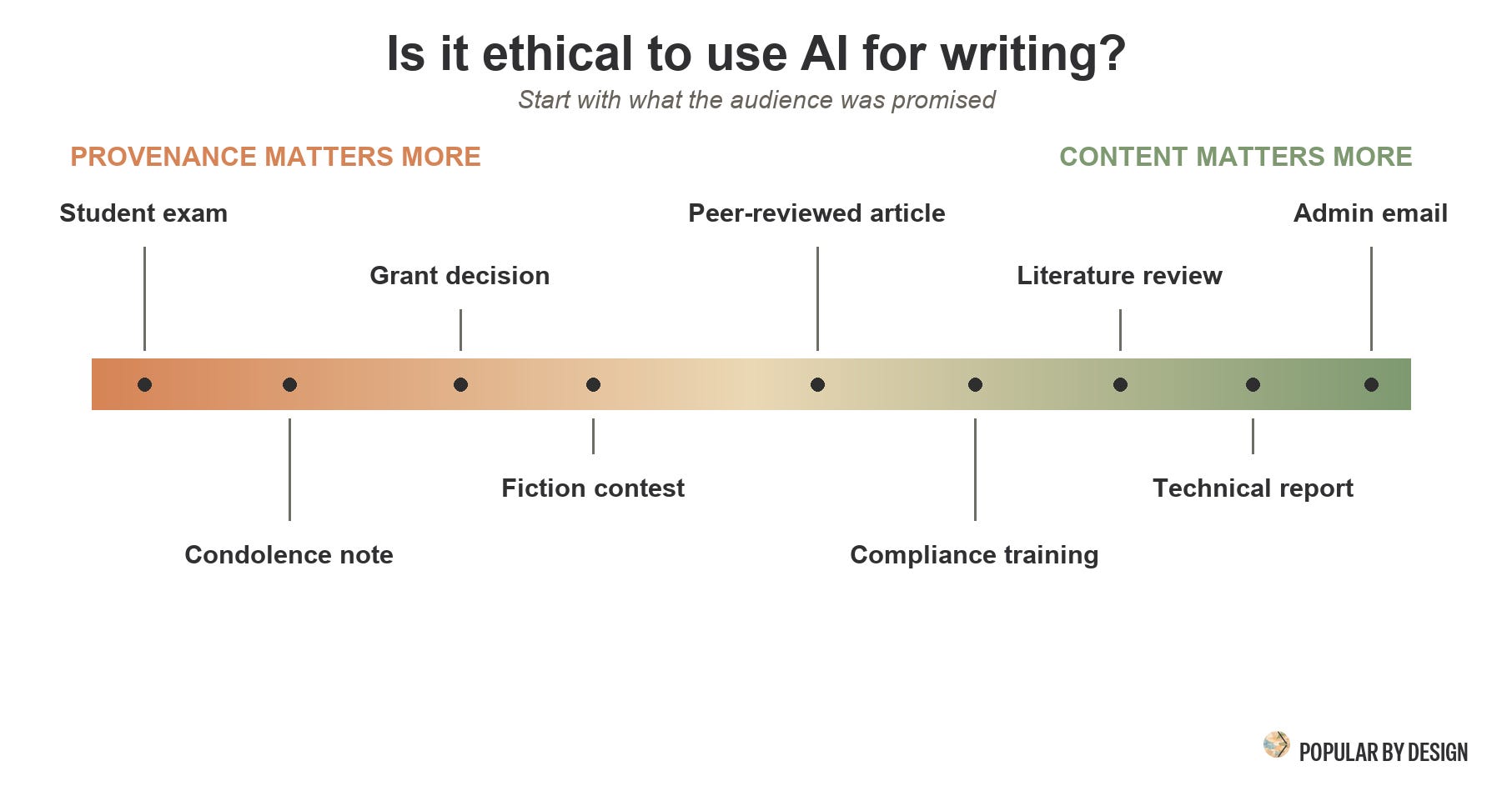
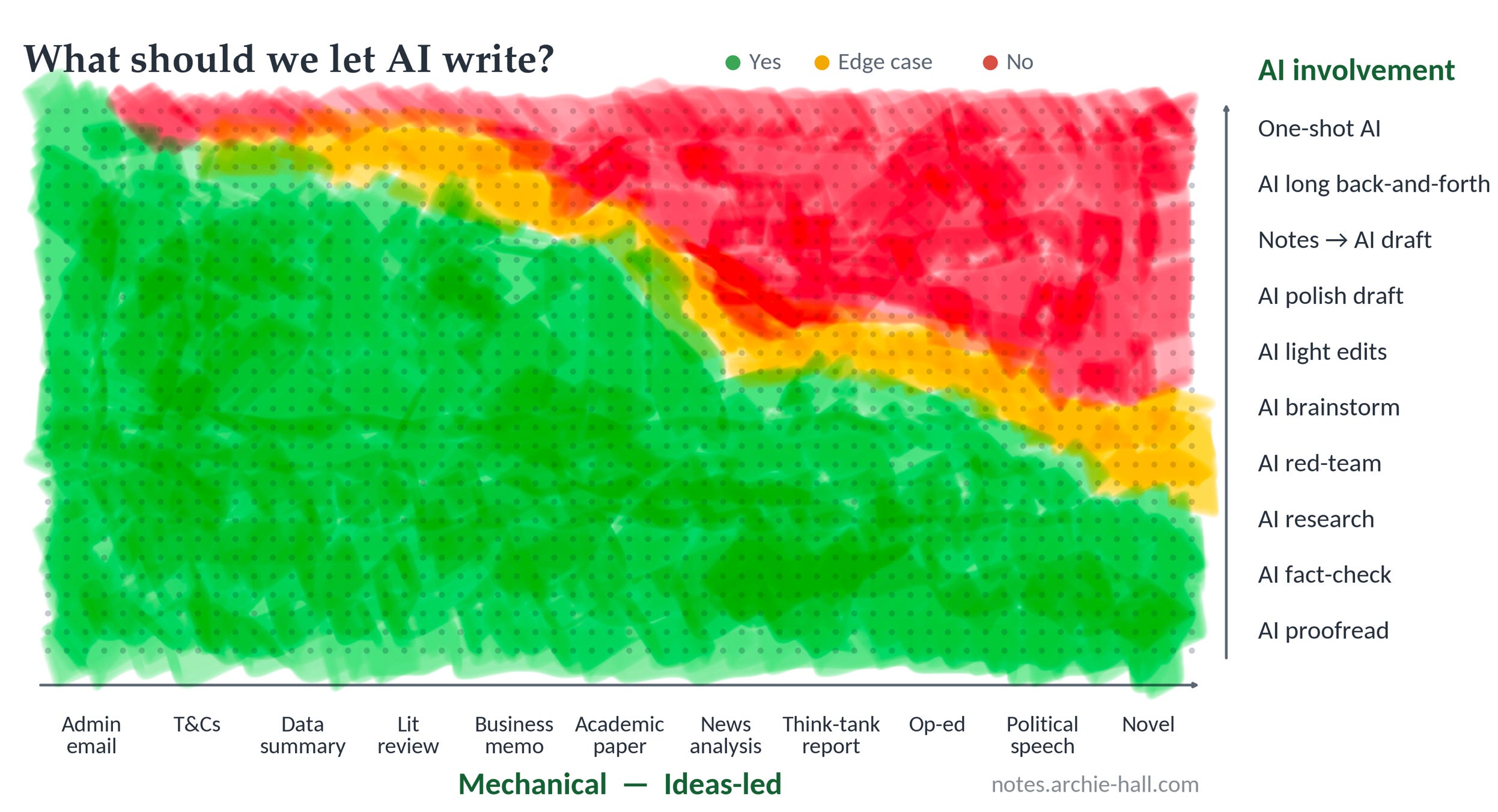
Archie Hall wrote a visual follow-up that turns my AI-writing spectrum into a two-dimensional chart. In the Pangram piece I put writing on a single provenance spectrum, from where provenance matters most to where only the content does. Archie rebuilds it on two different axes: how much of the work the AI did, from a one-shot prompt down to just fixing typos, and how mechanical or ideas-led the writing is, from admin emails to novels. It seems like Archie (and other folks I deeply respect like Lauren Gilbert, Emma McAleavy, and Jason Crawford) strongly disagree on both the usefulness and morality of AI writing, but having a chart like that is a genuinely useful upgrade that helps us see what exactly we disagree about (Archie’s yellow edge cases are my clear green yeses). It also makes me genuinely happy that nobody is trying to defend the human authenticity of admin emails :)
One last thing before I go. Big things are coming on the Fourth of July, for the world and for Popular by Design, and I will have much more to say very soon. Stay tuned!