



October has been a busy month with tons of events and links. It all started in Washington, DC, where Rebecca Wai—our newest team member—and I hosted the inaugural Making Immigration Better workshop at Notre Dame's Keough School Washington Office. We kicked off with a larger migration mixer open to the public, where Cornell's Johannes Haushofer talked about going from academic research to building Malengo, which helps talented students from low-income countries earn degrees abroad. The next day, about 20 researchers and practitioners from across the political spectrum spent a full day behind closed doors talking candidly about what is working in immigration policy and what isn't. We talked a lot about how public trust in an orderly system can make room for more generosity, and about new legal pathways like rotational work programs that could help aging countries fill jobs that can't be automated. It seems like most participants appreciated having room for conversations that are hard to have in public, so we plan to make it an annual event. We also had our first successful Popular by Design DC meetup in Dupont Circle, so stay tuned for more events soon!

A week later I was in Berkeley for The Roots of Progress Conference, which has become something I now look forward to every year. There I gave a talk on why top talent immigration must come first, both within immigration and the progress and abundance agendas. About 80% of American voters support bringing in more highly skilled immigrants, yet those movements treat the issue as too dangerous to touch. So, with some success, I’ve been trying to convince these folks to care more about top talent immigration and to see that it can be decoupled from the rest of our toxic debates. The sooner this happens, the better, because the clock is ticking with AI.
An important side benefit of the Progress conference is that you get lots of inspiration and guest post pitches, so here is the updated submission guide if you want to join us too. Here’s me talking to Kurtis Lockhart about the rotational migration issue and trying to convince him that migration research may be biased after all:

I spent the second half of the month in the UK, workshopping my new book project, Immigration for Realists, all across the country from Oxford to Newcastle, just after the paper version of the argument came out. Many thanks to everyone who hosted me, came to the talks, and pushed back on my provocations for such a great experience. It was fascinating to hear how people reacted, from more conservative audiences to more liberal ones. Somewhat surprisingly to me, what most people pushed back on the hardest was the idea that more or better temporary migration could ever be politically viable in Western democracies. British folks on both the right and the left seem very pessimistic about that, which I don’t think is accurate, so I will be writing more on that soon. And since immigration was not enough, I also paid my respects to Dr. John Snow and did some on-the-ground reporting on the UK’s other most contentious issue of today, the pedestrianization of Oxford Street.

In case you missed it: Earlier this month we ran a new guest post continuing our practical AI series on professional writing. Instead of worrying like many of us that AI will make things up, Steven Denney explains in How to Do Fact-Checking Right in the Era of AI how you can use it as a superhuman fact-checker on your side to boost your human writing.
Book mini review of the month:
Rogers Brubaker’s Gender Identity: The Career of a Category (Polity) traces how the term “gender identity” that began in medicine, describing rare sex disorders, became a contested legal and political category once people could invoke it to claim recognition and access to single-sex spaces. It’s a great book, succinct and to the point, and its comparison of the US and the UK is especially enlightening.
In the US, the fight over youth gender medicine and trans issues looks like a left–right battle fought through partisan legislation. In the UK and the socially liberal Nordic countries, nonpartisan regulators changed course after independent evidence reviews. I’ve met many folks in the US who have no idea that much of the opposition to some gender identity and trans legislation in Britain came from feminists and gay activists. As Brubaker suggests, a lack of sober analysis contributed to advocates’ overreach and the backlash that followed, a pattern that will sound familiar to anyone who studies immigration and other contentious issues.
Here are the October links (linking does not imply endorsement):
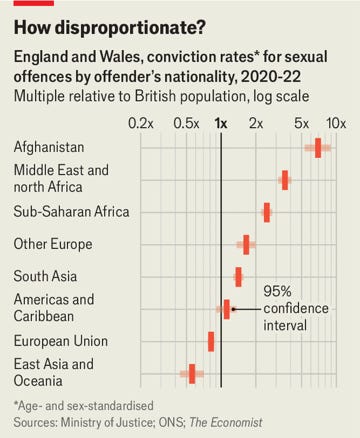
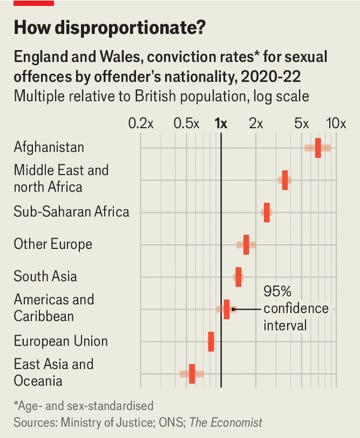
The Economist asks whether immigrants from some countries commit more sex crimes in Britain, using age- and sex-standardized conviction rates by the offender’s nationality. A hard look at the data suggests so, they write, “but it is hardly an epidemic.” This framing, alongside their choice to use a particular scale, enraged some people online. But can folks please just stop complaining about the log scale and appreciate that The Economist did this? I don’t think either scale choice changes the basic picture, which clearly shows the overrepresentation by origin. What matters is that the data is now public, which makes it much harder for malevolent actors with extreme ideologies on either side to just make stuff up. As someone who often complains that we experts shy away from uncomfortable truths on immigration and is currently writing a book about this, I feel like nature is healing.
Relatedly, Sascha Riaz showed earlier this year that the common approach of comparing local crime rates with immigrant shares is null by design. Immigrants are a small share of the population, so even large group-level differences get diluted in aggregate data.
Tom Clark and Jonathan Mummolo argue in a new essay, “Privileging Evidence in Empirical Social Science,” that research should be judged on the strength of its evidence, whatever the researchers’ identities or the political ends a finding may serve. They propose four minimal criteria for good evidence, from conceptual clarity to contestability. In a related piece, Stian Westlake offers a framework for judging the health of a social science research ecosystem by its rigor, pluralism, and impact.
If you want to understand why my British audiences were so pessimistic about temporary migration, Charles Talbot and David Shipley make the case in the Pimlico Journal that the care worker route was “the worst visa ever.” The Home Office expected between 6,000 and 40,000 applications a year, yet there were more than 130,000 care worker visa decisions in the 12 months to October 2023, with only one compliance officer per 1,600 sponsors. To me, their diagnosis points mostly to design flaws that can be fixed.
Tara Watson at Brookings proposes an H-1D visa for experienced direct care workers in the US, capped at 65,000 a year after an initial pilot, with a three-year renewable term and a path to a green card after six years. She puts the projected need at about 1.3 million additional direct care workers by 2036.
Fergus Peace argues that permanent settlement is not something you earn, warning that the UK’s proposal to stretch the qualifying period to 10 or 15 years moves toward a guest worker model. Anyone proposing rotational programs, myself included, needs to answer this rights-based objection.
Jesús Fernández-Villaverde asks what Spain’s population would look like if net immigration since 1995 had been zero. By his calculation, immigration added about 11 million people relative to that baseline, but the working-age share barely moved, from 64.2 to 66.3 percent. He argues that mostly low-skilled immigration into a highly redistributive welfare state has almost certainly worsened Spain’s long-term fiscal sustainability.
Bryan Caplan argues that we don’t just want the best people, calling the “Papa John’s” logic of better ingredients, better pizza “utter nonsense” when applied to immigration, since firms and households rely on lots of complementary lower-skilled workers. Having just argued for putting top talent first, I agree with him that it shouldn’t be the only thing. But I also wonder how much of his disagreement with Garett Jones is really about the place, scope, and policy design of rotational vs permanent immigration.
Lauren Gilbert and Luke Eure break down what JD Vance was up to at his immigration press conference, after the administration suspended Microsoft and seven other companies from the PERM program that employers use to sponsor green cards. They argue that the “indentured servants” framing and the H-1B wage claims don’t hold up, and conclude that the whole thing is best seen as a threat.
Microsoft president Brad Smith then warned the White House that discouraging skilled immigrants could undermine the “wealth and standard of living” of all Americans. My sense is that we need to have more of this. America’s best firms should be unapologetic about hiring on merit, and there is no America First without top talent.
Luke Eure, meanwhile, also lists three places where he would restrict immigration, from sham Day-1 CPT programs to concurrent H-1B loopholes and visa overstays, because you don’t need to be “pro-immigration” or “anti-immigration” on every single issue. More pro-immigration folks should do this exercise, both privately and publicly.
Jeremy Neufeld and his colleagues at IFP explain why DHS’s $100k OPT fee would break high-skilled immigration. The proposed rule would charge universities $70,000 for each graduate they recommend for OPT and another $30,000 for the STEM extension, while assuming no reduction at all in STEM participation. Their central estimate is that it would cost billions in annual GDP after ten years, which is why this clearly bad proposal is worth pushing back on. As Adam Ozimek put it, “the anti skilled immigration people really are the prison abolitionists of the right,” loud online but an unpopular fringe.
Richard Hanania asks whether immigration restrictionists are bad people and argues that moral judgment should focus on what people want to do about their preferences, with opposition to high-skilled immigration especially hard to justify. He also draws on my research showing that strict restrictionists are a minority who care unusually passionately about the issue.
Matthew Yglesias argues that what most Democrats want is for the border to become “an impermeable force field” so they can be lenient with everyone already inside, but there is no force field, and the only way to fix their credibility is to win an election and do a good job.
In a recent conversation with Yglesias, Jerusalem Demsas at The Argument also argues that highbrow economic rationalizations for anti-immigration politics are wrong on the merits, and that advocates should engage concerns about crime and disorder directly. I agree.
New Third Way polling by Sarah Pierce and colleagues finds that 58% of battleground voters disapprove of Trump’s immigration enforcement, yet Republicans still lead Democrats by 13 points on immigration and 30 points on border security. Pierce adds that rejecting Trump’s approach does not mean trusting Democrats to do better.
Blas Nuñez-Neto at the Searchlight Institute argues that the ACLU’s asylum plan is a path back to chaos, since the vast majority of people who claim asylum at the border are ultimately found not to merit protection.
Victor Kumar lays out how to save higher ed from AI cheating, arguing that administrators should license the Pangram detector and treat its results as evidence in disciplinary cases. As much as I don’t like Pangram policing for professional writing, schools are one of the few places where it makes perfect sense, mostly as a deterrent, so universities should adopt it ASAP.
Tom Pepinsky argues that false citations are fraud, whether the fabrication comes from a person or from AI. I agree, and I would say the same about attributing claims to sources that don’t make them, whether AI- or human-driven.
New Anthropic research by Amaç Herdağdelen and Hailey Joren, with Alex Tamkin, shows how AI agents shape experts’ judgment calls. In a randomized trial, professional data analysts went with their agent’s secretly assigned lean 86% of the time, and while 77% repeated the agent’s arguments afterward, only 15% credited the agent. Alex Imas calls it one of the most important pieces of social science on human and AI interaction he has seen in some time.
Many academics still believe that reviewing academic papers using AI is misguided and unethical, if not outright crazy. Well, in their now-viral draft describing their recent experiment on the topic, Gary King and Steven Worthington find that AI article reviews now beat human peer reviews at their best. Reviews written by Claude Opus 4.8 won 87% of head-to-head comparisons judged by human journal editors, and all of them when another AI model did the judging, against an unusually strong set of paid human reviews. I think we should be cautious about interpreting this study, but the idea that AI should not be part of peer review seems increasingly untenable. We should also remember that most slop has always been and still is human slop.
And lastly, the Halloween costume of the year award goes to Japan’s Population Pyramid:


As before, if you want me to write more about one of these or other related topics, let me know!