



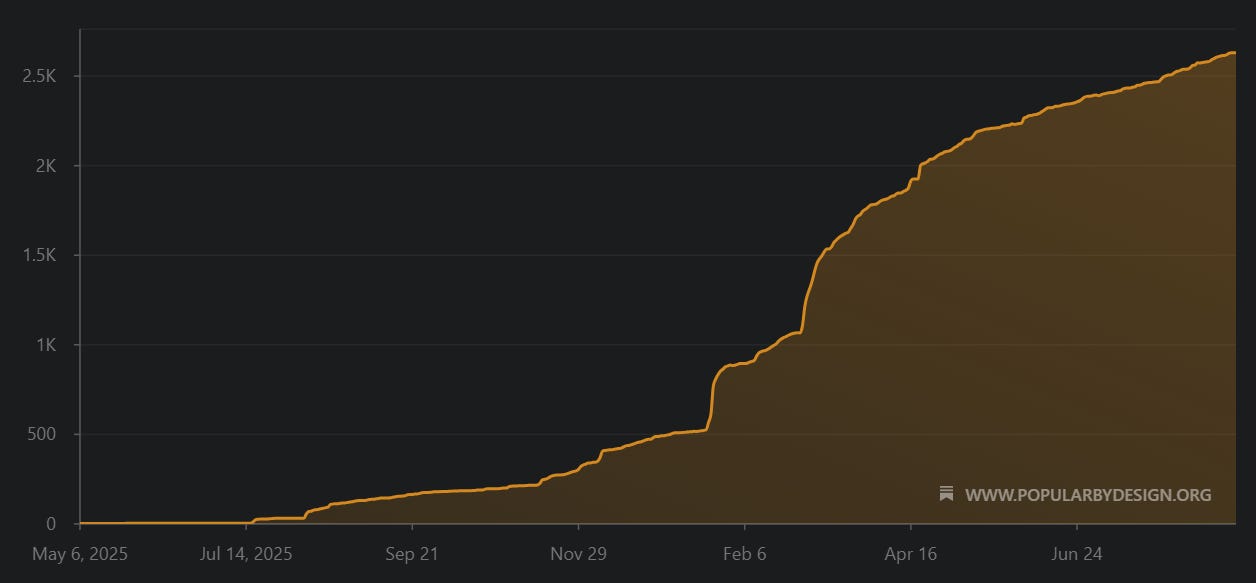
It is hard to believe, but Popular by Design turned one this month. When I started, this newsletter had only three subscribers. If you ask me how it all came about, it was… pretty random. On a whim, I applied for The Roots of Progress fellowship, and one of the required forms asked for my Substack account handle (which I did not have at the time, so I had to create one). When they accepted me, they made a public announcement basically implying that I write a newsletter.1 In any case, folks started signing up and DMing me about my new endeavor (which, to be clear, didn’t exist yet). So, to avoid total embarrassment, I started writing, launching my first piece on why skilled immigration is popular in August 2025. And it seemed like at least some of you actually liked it, which was a complete surprise.
Today there are more than 2,600 of you. Apart from a few viral pieces, what actually drove the growth is mostly you: quiet recommendations from readers and fellow writers did more than any spike, and I am grateful for every one of them. Popular by Design is far from being a household name (probably for the better), but it has now been mentioned or cited in several major publications, including The Atlantic, the Washington Post, the Wall Street Journal, and CNBC. The newsletter also stopped being just me: we have now run guest essays, and the scope has quietly widened from immigration to AI and population issues and credible policy design more broadly.
In case you missed it: In August I published How to Use AI for Public Engagement, the practical write-up of my Machine Collaborators talk on what agentic AI can do for researchers who want to reach the public. And we published the fourth guest essay of year one: Alejandro Iribas, a Spanish economist at Money & Macro, on making sense of the Spanish exception, or why the country running Europe’s biggest immigration boom has so little backlash so far. If you want to write the next one, the guidelines are here.
Since it is anniversary time, here are the ten most-read posts of year one:
The top two alone were read nearly 100,000 times, and six of the ten are not really about immigration policy. I have made my peace with that, partly because the detours turned out to be intellectually in line with my pragmatic immigration writing. I started this newsletter because of all the gaslighting and bullshit I kept seeing on my pro-immigration side. Watching many academics respond to AI made me think about it the same way: people were simply not thinking clearly (and they still aren’t on AI writing). From there it was a short step to writing about academia itself as an institution, which is losing credibility with each passing day, with no end in sight. That is, unless we change something.
Speaking of which: ever since my piece on the need for more conservatives in the social sciences came out last month, I’ve been trying to write a follow-up reflecting on the most common objections. But I keep rewriting it, because reality keeps giving us more bangers. When the Jason Arday scandal consumed Cambridge, I wrote that while many folks lament the loss of trust in higher education, the bigger issue is clearly the loss of our trustworthiness.2 One common response (from left-of-center academic) was basically, why bother restoring conservatives’ trust if they don’t care about the truth anyway? Well, unfortunately, at this point the situation at places like Cambridge and the BBC is so bad that they need to worry about restoring the trust of rank-and-file moderates, and even of some other left-of-center academics themselves, like me. For instance, I’m not sure I’d still feel comfortable talking to a BBC journalist or trusting they would report my research findings objectively on any sensitive issue like immigration or AI.
I also signed my first open letter, opposing Ghent University’s suspension of Nathan Cofnas, the philosopher who first documented Arday’s misconduct for the public. It has been extremely depressing to watch so many mainstream institutions, academics, and smart people on the left still excuse Arday’s data fabrications and his attacks on journalists, or prefer to treat the whole thing as a single aberration. Many also seem unable to grasp the simple idea that defending someone’s academic freedom does not imply endorsing their views, whatever they may be. As you can imagine given my previous experiences, for about a week, publicly signing the open letter made me about the worst person on the internet, according to Bluesky.

I mention the pile-ons because saying unpopular things in public costs something, and what makes it sustainable is knowing that readers actually value this kind of principled independence, wherever it lands. The newly introduced paid subscriptions are perhaps the clearest such signal I get. I turned them on in July alongside my essay on liberal nationalism, which set out this newsletter’s broader ambitions. Every essay stays free and will stay free, so upgrading is patronage in the old sense: it keeps the writing open for everyone and tells me to keep going where the arguments lead. And there is more coming this fall, from new guest essays to our first reader meetups.
Yep, there will also be at least two chances to meet in person this fall, if you are in or near Washington, DC. On Thursday, October 1, the Making Immigration Better workshop I am organizing at Notre Dame’s DC office opens with a public reception and keynote from Johannes Haushofer, the Cornell development economist who founded Malengo—one of the most impressive immigration startups out there. Drinks start at 5pm, the talk at 5:40, and I am sharing the registration form exclusively with readers here.
Then on Saturday morning, October 3, from 10 to noon before I fly out, I am hosting the first ever Popular by Design reader meetup over coffee in Dupont Circle: a much more informal setting, going beyond immigration to talk about all the things, from AI and policy design to viewpoint diversity. RSVP here and I will send the exact location to everyone who does. Space is limited for both events, so sign up early if you want to come. If this proves successful, we can also come up with another meetup in London later in October.
OK, here are the August links (linking does not imply endorsement):
The biggest immigration news of the month: David J. Bier reports that DHS has proposed a $103,265 fee merely to file an H-1B petition, stacking on the existing $100,000 proclamation charge. Petitions subject to the first fee already fell about 87%, and Bier calculates the government lost $28 million in net revenue in its first five months.
FIRE won a ruling that the two statutes Secretary Rubio has used to revoke visas and deport legal immigrants over pro-Palestinian speech, as in the Khalil and Öztürk cases, are unconstitutional under the First Amendment. According to the judge: “In the United States, freedom of speech belongs to the people. It is not the government’s to take.”
Mireille Paquet, Andrea Lawlor, and Colin Scott have a new open-access survey experiment with over 5,500 Canadians: immigrant candidates with prior Canadian work or study experience are clearly preferred, and the effect is larger among respondents with more negative views of immigration. A visible design feature that recruits its own constituency among skeptics is pretty much the thesis of my book, so I will be citing this one for a while.
Joseph Politano offers an insightful engagement with Justin Gest’s new book Democratic Drain: 88% of prospective migrants say there is limited freedom of expression at home, and in a conjoint survey experiment they were 27% more likely to pick a destination for being a democracy, a stronger pull than its economic growth. Politano pushes back on Gest’s worry that emigration drains democratization movements at the origin.
Luke Eure treats the Immigration Act of 1990 as the last successful expansion of legal immigration and asks what made it possible: it passed the Senate 89-8 while nearly half the public wanted immigration reduced, four years after the 1986 amnesty had been framed as closing the back door. It is pretty crazy to think that nothing comparable on legal immigration has passed in the 36 years since.
David J. Bier also reports that Senators John Curtis (R-UT) and Mark Kelly (D-AZ) introduced a state-sponsored visa bill: renewable three-year visas under a 500,000 cap, with allocations that expand or shrink based on states’ compliance records. Letting Utah and Arizona want different things is one of the few live ideas for breaking the congressional logjam, and it now has a bill number and a senator from each party attached.
Cris Ramón at the Ministry of Mobility Design wrote a manifesto for employment-based immigration design: immigration systems need explicit mission statements with measurable outcomes and the data infrastructure to adjust course. It is encouraging to see more people treating immigration policy as a design problem here on Substack.
Alan Gamlen at the ANU Migration Hub asks whether temporary migration can sustain labor markets and communities over the long term, or whether churn-based guestworker models undermine exactly the sectors that need stable workforces, like care and construction. He treats the guestworker question more seriously than the usual Gulf-model discourse does, which makes the piece worth your time whatever your prior.
Mihnea Cuibus at Oxford’s Migration Observatory walks through why UK small boat arrivals fell 44% in the first seven months of 2026 and lands on a straight answer: with EU-wide unauthorized crossings down and Syrian arrivals down 67% after Assad’s fall, it is genuinely hard to isolate what, if anything, UK policy did.
Ruy Teixeira and Karlyn Bowman note the glaring patriotism gap: Democratic pride in being American has fallen from 88% in 2001 to 27% today, a record low; Republican pride sits at 93%. Whatever else you take from it, the constituency for the liberal nationalism I wrote about in July seems to currently live almost entirely in one party, and that should worry everyone.
Hrishikesh Joshi makes the most careful recent case for why even committed cosmopolitans and effective altruists should price in immigration’s institutional effects, drawing on Garett Jones and evidence that roughly 40% of home-country trust attitudes persist across immigrant generations. He is explicit that none of this justifies current restrictive policy.
Lionel Page offers a mechanism for why sociology politicized more than its neighbors: weaker epistemic guardrails, from contested measurement to underdeveloped causal identification, left more room for politics when academia moved left. Meanwhile, Eboo Patel argues in Persuasion that sociology must be saved from itself, recalling his Oxford advisor’s warning against squeezing the world into your own worldview.
Lyman Stone points out that below-replacement fertility is not new: under the mortality of 1950, replacement was roughly three children per woman, so Japan and Bulgaria fell below replacement while their fertility rates still exceeded 2.2. That deflates the idea that we are in unprecedented territory without denying the trend.
Dan Williams makes a good point that the most consequential AI questions are effectively about people and institutions, and need expertise from all sorts of fields, from philosophy to social science. I should say that after my AI posts blew up, I was hesitant for a long time to claim any expertise here, but seeing how far behind most folks around me are has made me more OK with it, at least when it comes to opining on how researchers and public intellectuals can use AI. The fact that most smart people still don’t use agents is insane to me.
As before, if you want me to write more about one of these or other related topics, let me know! If year one taught me anything, it is that I should have started years earlier. The audience for pragmatic policy writing was always out there. So, thank you for being here, and see you in year two with more announcements and essays coming soon to an inbox near you.
Emma McAleavy, was it you?
That tweet went semi-viral and ended up leading the analysis section of AllSides' "Story of the Week" representing the center (alongside Al Jazeera for the left and The Spectator for the right).
Not me just going through and bookmarking every single post you link. Thank you for the roundups!
Man does nothing make less sense than the “but why do we need to earn [conservatives’] trust?” discussions. Maybe because the public doesn’t sort neatly into ideological monoliths, and also because we’re all certainly willing to spend conservatives’ tax and tuition dollars?